
Summarize This Article With AI
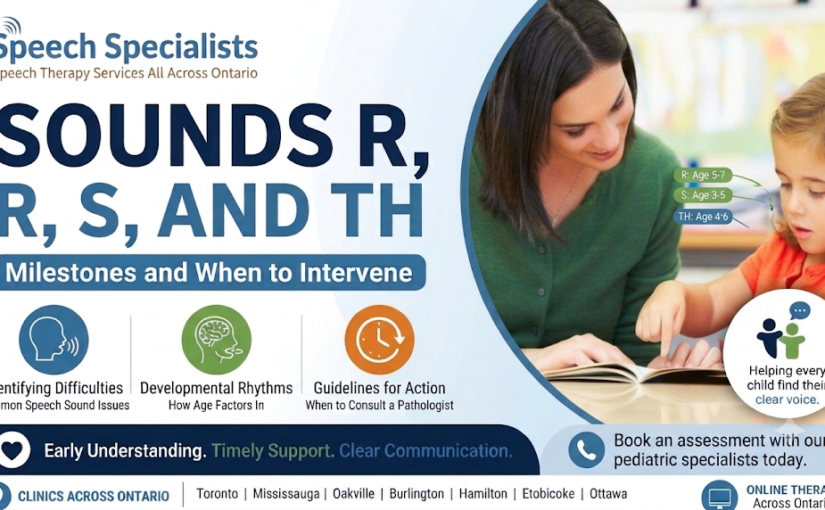
Alberta Health Services tells parents that most children say the R sound correctly by age 6, and the “th” in “teeth” by age 7 (R sound guidance, TH sound guidance). That is a wide window. It explains why a kindergartener who says “wabbit” is usually fine, while a Grade 2 student who still does may need a closer look.
Canadian parents hear different numbers depending on who they ask. A Hamilton-Wentworth school board resource says a typical four-year-old in kindergarten may not have R and TH yet (HWDSB speech and language supports), while the Alberta chart puts the finish line a couple of years later. Both can be true. They answer different questions: when children first try a sound, and when most of them have it.
Below, the Canadian guidance on R, S, and TH sits side by side, with the ages that matter and the signs that a speech assessment is worth booking.
What does the Canadian speech sound chart say?
The most detailed Canadian chart comes from Alberta Health Services (AHS). It lists the age by which most children can say each sound, based on research that tracked when 75 percent of children use each consonant. Two details matter before you read it. The research behind it was done with American children, and the chart covers English only.
| Age range | Sounds most children can say |
|---|---|
| 2 to 3 years | p, b, m, d, n, h, w, plus vowels |
| 3 to 4 years | t, k, g, ng, f, y |
| 4 to 5 years | s, z, l, sh, ch, j |
| 5 to 6 years | r, zh (as in “treasure”), voiced th (as in “the”) |
| 6 to 7 years | voiceless th (as in “teeth”) |
The chart also gives a rule of thumb for clarity. Parents can usually understand about half of a two-year-old’s speech, most of a three-year-old’s, and all of a four-year-old’s. If a child is much harder to follow than that, the issue is probably bigger than one tricky sound.
At what age should a child say the S sound?
Most children say a clear S by about age 5, according to AHS, and the chart places S and Z in the 4 to 5 year band. The mistakes AHS names are saying “t” for “s”, and a lisp, where “soap” comes out sounding like “thoap”.
A lisp in a four-year-old is common and usually not a worry. Speech and Hearing BC says a frontal lisp, where the tongue pokes forward, is common up to about 4 to 4½ years. Past that age it deserves attention.
Losing front baby teeth can also make S sound off for a while. That is usually temporary, and it is still worth mentioning to a teacher or speech-language pathologist if it lasts.
At what age should a child say the R sound?
Most children can say R correctly by age 6. The AHS chart puts it in the 5 to 6 year band, alongside the “zh” in “treasure” and the “th” in “the”.
R is hard partly because nobody can see it. AHS points out that children can’t watch how the sound is made, and explaining it in words rarely helps. The most common mistake is not moving the tongue the right way. Compare that with B or M, which a child can copy straight from a parent’s lips.
Is it normal for a 5-year-old to not say R?
Yes. A five-year-old who says “wed” for “red” is inside the age range on the Alberta chart. AHS suggests that parents of children under 6 try sound activities at home, such as pointing out R words during books and play, and that parents of children 6 or older who are worried talk to a speech-language pathologist. If your child is six and the R is still missing, that is the point to book an assessment for speech therapy for children instead of waiting another year.
What is the hardest sound for kids to say?
In practice, R and TH. They sit at the end of the AHS chart, the last to arrive, and R in particular is hard to see and hard to describe. A missing R or TH at age four or five rarely signals a problem by itself.
At what age should a child say the TH sound?
English has two TH sounds, and they arrive at different times. The voiced TH in “this” and “the” usually shows up between 5 and 6. The voiceless TH in “thumb” and “teeth” arrives between 6 and 7, and AHS says most children have it by 7.
Until then, children swap in an easier sound. AHS says the most common swaps are “t” and “f” for TH, so “think” turns into “tink” or “fink”. Parents can model the sound by putting the tongue between the teeth and blowing gently.
Because TH is last on the chart, a child can be right on schedule at seven and still sound a little off at five. Of the three sounds in this guide, it is the one least likely to be a concern early on.
What sounds should a 4-year-old be able to say?
By four, a child’s speech should be clear to the people around them all of the time, according to AHS. A four-year-old is in the middle of learning S, Z, L, SH, CH, and J, and may not have R or TH at all. A four-year-old who is easy to understand but says “wabbit” and “fumb” is a typical four-year-old.
The red flags have more to do with clarity than with any single sound. HealthLinkBC lists strangers having trouble understanding a child at 36 months among its warning signs for speech and language development.
What the Canadian numbers do and do not tell us
Three limits are worth knowing. First, age charts describe averages, not deadlines. The AHS chart marks the age when 75 percent of children use a sound, which leaves roughly one child in four still working on it.
Second, Canadian health authorities appear to lean on international research for these ages. The Alberta chart cites American data, so a child growing up with French or another language at home may follow a different path, and a speech-language pathologist can sort that out.
Third, prevalence figures vary with the definition. Speech-Language & Audiology Canada told a House of Commons committee that one in six Canadians has a speech, language or hearing disorder. An Ontario government announcement put the share of children who need help developing speech and language skills at about one in ten. Those numbers measure different things, so they should not be added together.
Access also depends on where you live. Ontario’s Preschool Speech and Language Program is free, needs no doctor’s referral, and serves children from birth until school entry, according to a York Region listing updated in 2025. The Canadian Stuttering Association notes that government-funded speech services exist for preschool and school-age children in most provinces, while adults mostly rely on the private sector (Canadian Stuttering Association). When a public route has a wait, some families book a private assessment while they stay on the public list, so the child isn’t left without support in the meantime.
How can parents help with speech sounds at home?
Children mostly learn sounds by listening, so the most useful habit is to give a correct model without turning it into a correction. The Hamilton-Wentworth resource suggests nursery rhymes, songs, drawing pictures of words that start with a new sound, and choosing books that repeat it . If your child says “tock” for “sock”, you can answer with “yes, a sock”, and carry on. Making a child repeat a word until it comes out right is rarely the better route.
When is it time to ask for a speech assessment?
Canadian sources point to a short list of triggers:
- A three-year-old whose speech strangers cannot understand
- An S that is still unclear or lisped after about age 5
- An R that is still missing at age 6 or older
- A TH that is still missing at age 7 or older
- Any child who cannot say the sounds expected for their age, which AHS says is the signal to contact a speech-language pathologist
A speech sound assessment looks at which sounds the child makes, how they make them, and how clear they are overall. If therapy is recommended, articulation therapy often works on one sound at a time, starting with the one that affects clarity most.
What if my child is on the borderline?
Many parents land somewhere between “probably fine” and “clearly a concern.” A child who is a few months past an age on the chart, is easy to understand, and is making progress can usually be watched for a while. Asking is still reasonable if you are unsure. A short assessment can confirm that everything is on track, and if it is not, starting earlier generally makes therapy easier for the child. Waiting to see rarely costs anything in the first case, but it can cost time in the second.
Quick summary: R, S, and TH by age
- S: Usually clear by about age 5. A lisp that continues past 4 to 4 1⁄2 is worth a closer look.
- R: Usually correct by age 6. A missing R at age 5 is typical, while one at age 6 or older is a reason to ask.
- Voiced TH (“this”, “the”): Usually arrives between 5 and 6.
- Voiceless TH (“thumb”, “teeth”): Usually arrives between 6 and 7. A missing TH at age 7 or older is a reason to ask.
- Overall clarity: Often more important than any single sound. A child who is hard for others to understand needs attention sooner than one who has only a few tricky sounds left.
The bottom line
The ages in this guide describe when most children master each sound, not when every child must. A five-year-old who says “wabbit” is on a normal path, and a seven-year-old who still says “fumb” is the point where it makes sense to get support. Keep modelling the correct sound, keep it relaxed, and trust your instincts if something doesn’t feel right.
If your child is past the ages above, or you are simply unsure, a speech-language pathologist can assess their sounds and tell you whether therapy would help. Book a speech assessment for your child today.
Need Help Choosing the Right Speech Therapy Clinic?
Speak with our team and book a speech assessment to determine the best therapy plan for your child or family member.