
Summarize This Article With AI
Heart & Stroke estimates that Canada has 108,707 strokes a year, roughly one every five minutes, and that 878,000 Canadians are living with stroke Heart & Stroke. One in three survivors is diagnosed with aphasia, according to its 2017 Stroke Report Heart & Stroke 2017. Others have speech that is slurred or slow, and some have trouble swallowing. All of it lands on a speech-language pathologist’s caseload.
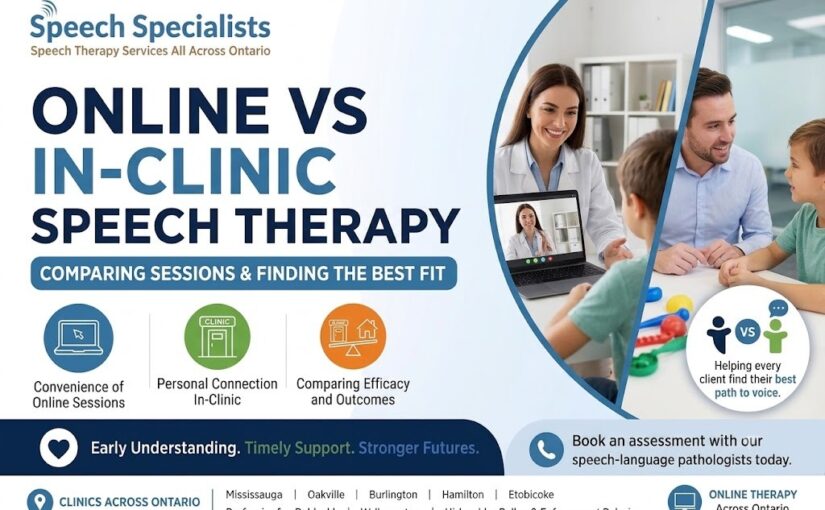
The next question is a practical one: do you travel to a clinic, or log on from the kitchen table? The Canadian Stroke Best Practice Recommendations answer part of it. They say in-person rehabilitation should be prioritized when possible, and that virtual rehabilitation is a viable option when it suits the person, the goals of therapy, and current health Canadian Stroke Best Practices. That is a more careful position than either side’s marketing.
What follows covers what the guidance and research say, where online therapy works, where it does not, and how to decide.
What do Canadian stroke guidelines say about online speech therapy?
The virtual rehabilitation section makes several points that matter here. Virtual care is a reasonable alternative when an in-person session is not feasible or available, and an adjunct when the goals of a session can be met virtually. That recommendation is rated strong, with moderate-quality evidence. The section also says all rehabilitation disciplines should consider virtual technology for assessment and therapy, naming speech and language therapy for aphasia as an example, though that recommendation rests on low-quality evidence. Where a person is eligible for both options, clinicians should weigh the person’s preference Canadian Stroke Best Practices.
Read together, Canadian guidance backs online therapy where in-person care is out of reach, stays cautious about it as a blanket replacement, and puts the patient’s choice into the decision.
Is online speech therapy as effective as in-clinic therapy after a stroke?
For many people the results look comparable, but the evidence is still building. The guideline’s evidence summary cites a 2020 Cochrane review in which virtual care was used successfully to treat speech and language impairments after stroke Canadian Stroke Best Practices. A review co-authored by UBC researcher Brodie Sakakibara, which was partly funded by Heart & Stroke, concluded that telerehabilitation also works for people recovering from stroke, while noting that clinicians prefer face-to-face care and turn to virtual care when it is not feasible UBC.
The same guideline is frank about the gaps. It says there is limited published evidence on how safely and reliably standardized assessment tools can be given over video after a stroke. That is a reason to ask your clinician how they will assess you online, not a reason to rule it out.
Can aphasia be treated online?
Yes, with adjustments. The guidance names speech and language therapy for aphasia as one of the therapies clinicians should consider delivering virtually, and it says that for people with communication impairments such as aphasia, assessment tools should be adapted for virtual use Canadian Stroke Best Practices. In practice, that means building in support. The Aphasia Institute’s point is that people with aphasia remain competent even when talking and understanding are hard, and can take part in decisions when the right support is provided.
Mood and motivation shape how well any session goes, in a clinic or on a screen. The guidance says screening for mood and cognitive changes should be a routine part of virtual rehabilitation, so expect questions about both.
When does in-clinic therapy make more sense?
Swallowing is the clearest case. Published estimates of dysphagia in the acute stage of stroke range from 19 to 65 percent, depending on lesion location, timing, and assessment method, and the guidelines call for instrumental tests such as videofluoroscopy or FEES when a bedside check suggests poor airway protection Canadian Stroke Best Practices. Those tests need equipment, which means a hospital or specialized clinic.
In-person sessions also suit people who face the challenges the guidance lists: cognitive or visual changes, low digital literacy, discomfort with technology, or unreliable internet. The guidance adds that when an assessment tool cannot be fully given on video, a hybrid of in-person and virtual assessment should be considered Canadian Stroke Best Practices.
When does online therapy make more sense?
Distance and transport come first. The guidance says virtual rehabilitation gives people in isolated or rural communities access to specialized services and reduces or removes the transportation problems stroke survivors and caregivers commonly face. That counts for a lot when Heart & Stroke reports that half of Canadians living with stroke need help with daily activities, including getting around Heart & Stroke. A weekly drive can be a bigger obstacle than the therapy itself.
Steady, repeated work is where online speech therapy fits best. Practice built around talking, naming, and conversation, such as aphasia therapy and dysarthria therapy, is easier to move to video than treatment that needs hands-on or equipment-based work.
One practical point from the guidance: a support person nearby helps with technology, remembering information, and safety. If nobody can sit with you, say so when you book.
| Factor | Online | In-clinic |
|---|---|---|
| Access | Reduces or removes travel; reaches rural and remote communities | Needs transportation, which is a barrier for many survivors |
| Assessment | Tools must be suited to video; some cannot be fully given online, so hybrid is considered | Full range of tools, including instrumental swallowing tests such as videofluoroscopy |
| Technology | Needs a device, stable internet, and comfort with video | Nothing beyond getting there |
| Support person | Recommended nearby for technology, memory, and safety | Clinic staff on site |
| Licensing | Clinician may need licences in both their province and yours | Local clinician |
| Best suited to | Speech and language therapy when the goals can be met on video | Swallowing, complex assessment, and people who struggle with technology |
Does provincial health insurance cover speech therapy after a stroke?
Coverage is uneven. Government-funded speech-language pathology for adults exists in some Canadian cities, usually in hospital settings, but most adults end up in the private sector, according to the Canadian Stuttering Association Canadian Stuttering Association. In British Columbia, the Medical Services Plan does not cover private speech, language, or swallowing services, and Speech and Hearing BC points to extended health plans, and WorkSafeBC for injuries from workplace accidents Speech and Hearing BC. If you are exploring adult speech therapy, ask your insurer whether virtual sessions are covered as well as clinic visits.
Licensing matters too. The guidance notes that licensing for virtual care varies among provinces and territories, and that clinicians may need to be licensed where they work and where the person receiving care lives Canadian Stroke Best Practices. Ask any online provider where they are registered.
How long does speech recovery take after a stroke?
March of Dimes Canada says there is no timetable for stroke recovery, and that Canadian best practices support starting rehabilitation as soon as possible after a stroke, typically while the survivor is still in hospital March of Dimes Canada. The Aphasia Institute describes aphasia as usually the lasting result of a stroke or brain injury, and says over 100,000 Canadians are living with it today. Online therapy helps in that long stretch because sessions can continue when travel becomes hard.
Which option fits you?
The Canadian guidance points toward matching the format to the person. Here is how that tends to play out:
- You live far from a clinic, have aphasia or slowed speech, can see and hear the screen, and have someone nearby: start online.
- You have trouble swallowing, or new or changing problems with memory, vision, or understanding: start in person, and ask about a hybrid plan later.
- You are not sure: have the first assessment in person, then move follow-up sessions online. The guidelines recognize fully virtual and hybrid formats.
Preference counts, and the guidance says so. If you are eligible for both formats, your own comfort is a legitimate tiebreaker. The stroke systems-of-care guidance reports that people with stroke value the flexibility of virtual care and recognize a benefit in combining virtual and in-person visits at different points in recovery Canadian Stroke Best Practices. Try a few sessions, then tell your clinician what is working. A plan can shift from fully online to hybrid, and back, as your recovery changes.
Questions to ask before you book
Whichever format you lean toward, a few questions help you judge whether a provider is a good fit:
- How will you assess my speech, language, or swallowing, and can that be done properly over video?
- Are you registered to practise in my province, and where?
- Will my extended health plan, employer benefits, or other coverage pay for virtual sessions as well as clinic visits?
- Does someone need to sit with me during sessions, and what should that person be ready to help with?
- If my needs change, can we move between online, in-person, and hybrid sessions?
A good clinician will answer these plainly. If you get vague answers, that tells you something too.
The bottom line
Neither format is better for everyone. Canadian stroke guidance backs virtual care where in-person therapy is out of reach, and it also says in-person rehabilitation should be prioritized when possible. Online therapy suits steady, conversation-based work like aphasia and speech therapy, especially if travel is a barrier and someone can support you. In-person care suits swallowing concerns, complex assessment, and people who find technology a struggle.
Need Help Choosing the Right Speech Therapy Clinic?
Speak with our team and book a speech assessment to determine the best therapy plan for your child or family member.