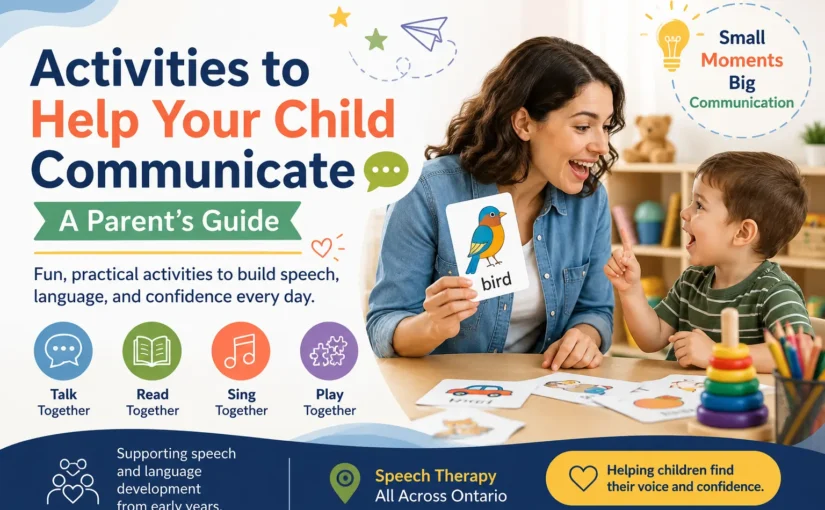
Learning to communicate is one of the most exciting milestones in your child’s early years. From your baby’s first smile to their first words and conversations, every interaction helps build the foundation for speech, language, learning, and social development.
The good news is that you don’t need expensive toys or special lessons to encourage communication. The most effective activities happen during everyday moments—reading together, singing songs, playing games, talking during meals, and simply spending quality time with your child.
Whether your baby is just beginning to babble or your toddler is learning to form sentences, this guide shares practical, evidence-based activities recommended by speech-language pathologists to support communication at every stage of development.
We’ll also explain when speech milestones vary from what’s expected and when it may be helpful to seek professional support.
What Are the Best Activities to Help Your Child Communicate?
The best communication activities are simple, interactive, and part of your everyday routine. They encourage your child to listen, understand, imitate sounds, use words, and engage with others.
Some of the most effective speech and language activities include:
- Talking to your child throughout the day
- Reading books together every day
- Singing nursery rhymes and action songs
- Playing pretend games
- Naming everyday objects and actions
- Giving your child choices instead of guessing what they want
- Copying your baby’s sounds and facial expressions
- Playing turn-taking games like Peekaboo
- Asking open-ended questions as your child grows
- Limiting passive screen time and encouraging face-to-face interaction
Consistency matters more than complexity. Even spending 15–20 minutes each day engaging with your child through play and conversation can significantly support speech and language development.
Key Takeaways
✔ Communication begins long before a child says their first word.
✔ Everyday routines provide the best opportunities for language learning.
✔ Talking, reading, singing, and playing together help children develop stronger speech and language skills.
✔ Every child develops at their own pace, but understanding age-appropriate milestones helps identify when extra support may be needed.
✔ Early speech therapy can improve communication, confidence, learning, and social interaction when delays are identified early.
Why Communication Activities Matter
Communication is much more than learning to speak. It includes understanding language, expressing needs, using gestures, listening, taking turns in conversations, and building relationships with others.
During the first three years of life, a child’s brain develops at an incredible pace. Every conversation, song, story, and playful interaction creates new neural connections that support future learning.
Research consistently shows that children who experience rich language environments are more likely to develop:
- Strong vocabulary
- Better listening skills
- Improved speech clarity
- Greater confidence communicating
- Better social interactions
- Stronger literacy and reading skills
- Improved school readiness
The best part is that these learning opportunities happen naturally during everyday life.
You don’t need to schedule formal lessons. Talking while preparing dinner, reading before bedtime, singing in the car, or describing what you’re doing during grocery shopping all help children understand language and build communication skills.
Speech-language pathologists often encourage parents to focus on quality interactions rather than the number of words spoken. A warm, responsive conversation where you follow your child’s interests is far more valuable than asking repeated questions or expecting perfect pronunciation.
Remember that communication develops gradually. Babies first learn to make eye contact, smile, and respond to voices before they begin babbling. These early interactions are just as important as first words because they lay the foundation for future language development.
Speech and Language Milestones by Age
Every child develops differently, but there are common communication milestones that help parents understand what to expect. Missing one milestone doesn’t always mean something is wrong, but consistently delayed skills may be worth discussing with a speech-language pathologist.
| Age | Typical Communication Skills | When to Speak with a Speech Therapist |
|---|---|---|
| 0–3 Months | • Smiles • Makes eye contact • Startles to sounds • Coos • Recognizes familiar voices |
• Limited eye contact • No response to sounds • Very quiet vocalizations |
| 4–6 Months | • Laughs • Squeals • Babbles • Turns toward voices • Enjoys interaction |
• Rare babbling • Limited social engagement • Doesn’t respond to familiar voices |
| 7–12 Months | • Responds to name • Understands simple words • Waves goodbye • Points to objects • Says “mama” or “dada” meaningfully |
• Doesn’t respond to name • No gestures (pointing or waving) • Little babbling |
| 12–18 Months | • Says several words • Follows simple directions • Points to objects • Imitates words |
• Fewer than 10 words • Limited understanding • Doesn’t point |
| 18–24 Months | • Uses 50+ words • Combines two words (e.g., “more milk”) • Follows two-step directions |
• Doesn’t combine words • Difficult to understand • Very limited vocabulary |
| 2–3 Years | • Speaks in short sentences • Asks simple questions • Enjoys conversations • Follows simple stories |
• Speech is difficult to understand • Limited sentences • Struggles interacting with others |
Remember: Milestones are guidelines, not strict rules. If you’re concerned about your child’s communication at any age, an early assessment can provide reassurance or identify areas where support may help.
Activities to Help Babies Communicate (0–6 Months)
Although babies don’t use words during the first few months, they are constantly learning how communication works. Every smile, cuddle, sound, and interaction teaches them that communicating with others is enjoyable and meaningful.
Here are some simple activities you can do every day.
1. Talk Face-to-Face
One of the easiest ways to encourage communication is simply talking with your baby throughout the day.
Describe what you’re doing while changing diapers, preparing bottles, or going for a walk.
Instead of saying only “Let’s go,” try:
“We’re putting on your little blue socks. Now we’re going outside to see the trees. Can you hear the birds?”
Your baby may not understand every word yet, but they’re learning speech sounds, rhythm, and conversation patterns.
Skills Developed
- Listening
- Attention
- Early vocabulary
- Social interaction
2. Copy Your Baby’s Sounds
When your baby coos or babbles, imitate the sounds they make and wait for their response.
If they say:
“Ahhh.”
You respond:
“Ahhh!”
Then pause.
This back-and-forth interaction teaches one of the most important communication skills—taking turns in conversation.
Over time, your baby learns that their sounds have meaning and encourage others to respond.
Skills Developed
- Turn-taking
- Social communication
- Early conversation skills
- Vocal play
3. Sing Songs and Nursery Rhymes
Songs naturally introduce rhythm, repetition, and new vocabulary, making them excellent for language development.
Simple favourites like Twinkle, Twinkle Little Star, Itsy Bitsy Spider, or Wheels on the Bus encourage babies to listen, anticipate familiar words, and eventually join in with actions or sounds.
Adding hand movements or facial expressions makes songs even more engaging and supports early understanding.
Skills Developed
- Listening
- Memory
- Sound recognition
- Word learning
4. Play Peekaboo
Peekaboo is more than just a fun game—it teaches babies that people and objects continue to exist even when they can’t be seen, a concept known as object permanence.
It also encourages anticipation, eye contact, smiling, and social interaction.
Pause before saying “Peekaboo!” to give your baby a chance to respond with excitement or sounds.
Skills Developed
- Social engagement
- Turn-taking
- Joint attention
- Early communication
5. Narrate Your Day
Babies learn language by hearing it repeatedly in meaningful situations.
Talk through everyday routines such as:
- Bath time
- Feeding
- Dressing
- Grocery shopping
- Walks outside
- Bedtime
Use simple, clear sentences while emphasizing important words.
For example:
“Here’s your cup. Let’s drink some milk. Mmm… cold milk!”
The more meaningful language your baby hears, the stronger their foundation for future communication.
Activities to Help Babies Communicate (6–12 Months)
Between 6 and 12 months, babies become much more interactive. They begin responding to their name, recognizing familiar words, pointing to objects, using gestures, and experimenting with different sounds. This is the perfect time to introduce simple play-based activities that encourage communication naturally.
Remember, the goal isn’t to make your baby say more words—it’s to help them understand that communication is enjoyable and meaningful.
1. Name Everything Around You
Babies learn words by hearing them repeatedly in everyday situations.
Instead of pointing silently, describe what your baby is looking at.
For example:
“That’s a dog! Look at the big brown dog.”
“Here’s your spoon. Spoon. Let’s eat.”
“Look at the red ball!”
Repeating important words helps babies connect sounds with objects.
Why it helps
- Builds vocabulary
- Improves listening skills
- Strengthens word recognition
- Encourages language understanding
2. Encourage Pointing
Pointing is one of the biggest communication milestones before children begin talking.
When reading books or playing together, encourage your baby to point.
You can ask:
- Where’s the cat?
- Can you find the ball?
- Where’s Mommy?
Celebrate every attempt, even if they don’t point to the correct picture.
Pointing teaches babies that communication is a way to share attention and ideas with others.
Why it helps
- Develops joint attention
- Improves receptive language
- Builds early vocabulary
- Encourages communication
3. Read Picture Books Every Day
You don’t need to read every word on the page.
Instead:
- Point to pictures
- Name familiar objects
- Make animal sounds
- Let your baby turn the pages
- Pause so they can respond
Books with colourful pictures and simple words are perfect at this age.
Reading together for just 10–15 minutes each day builds strong language skills and creates a lifelong love of books.
Why it helps
- Improves vocabulary
- Builds listening skills
- Develops attention
- Supports early literacy
4. Use Gestures While Talking
Babies often communicate with gestures before words.
Use simple gestures during everyday conversations:
- Wave goodbye
- Clap hands
- Blow kisses
- Nod yes
- Shake your head no
- Raise your arms for “Up”
Children naturally begin copying these actions before saying the words.
Gestures reduce frustration and encourage spoken language to develop naturally.
Why it helps
- Supports expressive language
- Improves understanding
- Encourages imitation
- Builds confidence
5. Play Cause-and-Effect Games
Simple toys that make sounds or move when pressed help babies understand that their actions create results.
Examples include:
- Musical toys
- Pop-up toys
- Rolling balls
- Stackable cups
- Push-and-go cars
As your child plays, describe what’s happening.
“You pushed the button! The music started!”
“The ball is rolling!”
Why it helps
- Improves listening
- Introduces action words
- Builds attention
- Encourages communication
6. Make Animal Sounds
Animal sounds are often easier for babies to imitate than full words.
Instead of saying only:
“Dog.”
Say:
“The dog says woof!”
“The cow says moo!”
“The duck says quack!”
Children love copying fun sounds, making this one of the easiest ways to encourage speech.
Why it helps
- Encourages sound imitation
- Develops speech
- Expands vocabulary
- Makes learning fun
Concerned About Your Child’s Communication Development?
Activities to Help Toddlers Communicate (1–2 Years)
Between one and two years, children usually begin saying their first meaningful words and gradually combine them into simple phrases.
This stage is all about encouraging communication through play rather than expecting perfect speech.
1. Offer Choices
Instead of guessing what your child wants, offer simple choices.
For example:
“Would you like milk or water?”
“Do you want the red ball or the blue ball?”
Even if your child points, say the word for them.
“Milk? Great! Here’s your milk.”
Giving choices encourages children to communicate instead of relying only on gestures.
Why it helps
- Builds expressive language
- Increases vocabulary
- Encourages decision-making
- Supports sentence development
2. Pretend Kitchen Play
Children learn best through pretend play.
Cook together using toy food.
Feed teddy bears.
Pretend to make tea.
Talk about everything you’re doing.
“The soup is hot.”
“Let’s cut the apple.”
“Teddy is hungry.”
Pretend play naturally teaches nouns, verbs, colours, actions and simple conversations.
Why it helps
- Improves vocabulary
- Encourages conversation
- Builds imagination
- Supports language development
3. Bubble Games
Bubbles are one of the favourite activities used by speech-language pathologists.
Blow bubbles.
Pause.
Wait for your child to request more.
They may say:
- More
- Bubble
- Pop
- Again
Even pointing or making eye contact is communication.
Model the words before blowing more bubbles.
Why it helps
- Encourages requesting
- Develops turn-taking
- Improves eye contact
- Builds vocabulary
4. Build with Blocks
Building blocks creates endless opportunities for conversation.
Talk about:
- Big block
- Small block
- Blue block
- Up
- Down
- Crash!
Children love hearing action words while they play.
Why it helps
- Expands vocabulary
- Develops listening skills
- Introduces concepts
- Encourages interaction
5. Sing Action Songs
Songs with actions make learning language enjoyable.
Great choices include:
- Wheels on the Bus
- If You’re Happy and You Know It
- Head, Shoulders, Knees and Toes
- Old MacDonald Had a Farm
Pause before key words to encourage your child to finish the song.
Why it helps
- Improves memory
- Develops listening skills
- Encourages speech imitation
- Introduces new vocabulary
6. Expand What Your Child Says
When your toddler says one word, expand it into a short sentence.
Child:
“Car.”
Parent:
“Yes! That’s a big blue car.”
Child:
“Dog.”
Parent:
“The dog is running.”
This naturally introduces new vocabulary and grammar without correcting your child.
Why it helps
- Builds longer sentences
- Expands vocabulary
- Supports grammar development
- Encourages conversation
Also Read: What Age Should a Child Start Speech Therapy? A Hamilton Parent’s Guide
Activities to Help Children Communicate (2–3 Years)
By age two, children begin asking questions, following conversations and using short sentences.
These activities encourage them to communicate with confidence.
1. Pretend Grocery Store
Set up a pretend shop using toys or household items.
Take turns being the customer and cashier.
Ask questions like:
- What would you like?
- How many apples?
- What colour is the banana?
- Can I help you?
Role-playing helps children practise real-life conversations.
Why it helps
- Builds conversational skills
- Improves vocabulary
- Encourages social interaction
- Develops confidence
2. Treasure Hunt
Hide toys around the house.
Give simple clues.
“Look under the chair.”
“Find something soft.”
“Can you find something red?”
Listening carefully while following clues helps children understand language more effectively.
Why it helps
- Improves listening
- Builds vocabulary
- Develops problem-solving
- Encourages following directions
3. Storytelling Together
Instead of reading every word, ask your child questions about the pictures.
For example:
“What is the girl doing?”
“What do you think happens next?”
“Why is the dog happy?”
This encourages children to describe events using complete sentences.
Why it helps
- Improves storytelling
- Builds vocabulary
- Develops imagination
- Encourages conversation
4. Play Simon Says
Simple movement games help children listen carefully.
Examples:
- Simon says touch your nose.
- Simon says clap your hands.
- Simon says jump.
- Simon says find something green.
Children learn to understand instructions while having fun.
Why it helps
- Improves listening
- Builds attention
- Encourages following directions
- Develops vocabulary
5. Puppet Conversations
Children often communicate more confidently with puppets or stuffed animals.
Ask questions like:
“What’s your name?”
“What do you like to eat?”
“Where are you going today?”
Many children who are shy enjoy talking through pretend characters.
Why it helps
- Builds confidence
- Encourages conversation
- Develops imagination
- Improves sentence formation
6. Cook Together
Simple cooking activities create endless language opportunities.
Talk about:
- Colours
- Shapes
- Numbers
- Ingredients
- Actions
Examples:
“Let’s stir the batter.”
“Pour the milk.”
“The banana is yellow.”
Cooking teaches vocabulary while making everyday routines fun.
Why it helps
- Improves sequencing
- Builds vocabulary
- Encourages listening
- Develops following directions
7. Describe and Guess
Choose an object without showing it.
Describe it.
“It’s round.”
“It’s red.”
“You can eat it.”
Ask your child to guess the object.
Then let them describe something for you to guess.
This game develops descriptive language, thinking skills and conversation.
Why it helps
- Builds vocabulary
- Encourages descriptive language
- Improves reasoning
- Supports conversation
10 Daily Habits That Help Your Child Communicate Better
Helping your child communicate doesn’t require expensive toys or structured lessons. Small, consistent interactions throughout the day have the biggest impact on speech and language development.
1. Talk During Everyday Activities
Describe what you’re doing while cooking, dressing, shopping or cleaning.
2. Read Together Every Day
Reading for just 10–15 minutes daily introduces new vocabulary and strengthens listening skills.
3. Follow Your Child’s Interests
Children learn more when conversations focus on what they’re already curious about.
4. Give Your Child Time to Respond
Pause for 5–10 seconds after asking a question. This gives children time to process and respond.
5. Reduce Passive Screen Time
Real conversations and interactive play are far more valuable than watching videos.
6. Expand Your Child’s Words
If your child says “Truck,” respond with “Yes, that’s a big blue truck.”
7. Encourage Turn-Taking
Take turns talking, rolling a ball or building blocks to teach the rhythm of conversation.
8. Ask Open-Ended Questions
Instead of yes-or-no questions, ask:
- What was your favourite part of today?
- What do you think will happen next?
- How did you build that tower?
9. Praise Communication
Celebrate every attempt to communicate, even when words aren’t perfectly clear.
10. Make Communication Fun
The more enjoyable conversations are, the more motivated your child will be to communicate.
Common Mistakes That Can Slow Down Your Child’s Communication Development
Every child learns to communicate at their own pace, but certain everyday habits can unintentionally reduce opportunities for speech and language development. The good news is that small changes in how you interact with your child can make a big difference.
1. Speaking for Your Child Too Often
It’s natural to want to help your child, especially when you know what they need. However, answering for them or anticipating every request reduces their motivation to communicate.
Instead of immediately handing them a toy or snack, pause and encourage them to use a word, gesture, or even eye contact before responding.
Try this instead: Give your child a few extra seconds to express themselves before stepping in.
2. Asking Too Many Questions
Questions are important, but asking one after another can feel like a test.
Instead of saying:
- What colour is this?
- What’s that?
- What’s the dog doing?
- What sound does a cow make?
Try commenting instead.
“The dog is running!”
“That’s a big red ball!”
Comments model language without putting pressure on your child.
3. Correcting Every Mispronounced Word
Children learn through practice. Constantly correcting pronunciation can discourage them from speaking.
If your child says:
“I see a tat.”
Instead of saying,
“No, it’s a cat.”
Respond naturally:
“Yes! That’s a cat. The cat is sleeping.”
This reinforces correct pronunciation while keeping the conversation positive.
4. Too Much Passive Screen Time
While educational programs can introduce new words, children learn language best through real conversations with parents and caregivers.
Interactive play, reading, and face-to-face communication help develop skills that screens simply can’t replace.
If your child uses screens, watch together and talk about what you see.
5. Not Giving Enough Wait Time
Children need time to process language before responding.
After asking a question or making a comment, wait at least 5–10 seconds.
This simple strategy often leads to longer responses and encourages independent communication.
6. Forgetting to Read Every Day
Reading is one of the most effective ways to build vocabulary and language skills.
Even just 10 minutes of shared reading each day exposes children to words and ideas they may not hear in everyday conversations.
Remember, you don’t have to read every word. Talking about the pictures is just as valuable.
Signs Your Child May Need Speech Therapy
Every child develops differently, but some communication challenges shouldn’t be ignored. Early support often leads to better outcomes because young children’s brains are especially receptive to learning new skills.
You may benefit from speaking with a speech-language pathologist if your child:
- Doesn’t respond to their name by 12 months
- Rarely babbles by 9–10 months
- Doesn’t point, wave, or use gestures by 12 months
- Says fewer than 10 words by 18 months
- Isn’t combining two words by age 2
- Has difficulty following simple instructions
- Is difficult for family members to understand after age 2
- Frequently becomes frustrated because others don’t understand them
- Stops using words or communication skills they previously had
- Avoids interacting with other children
- Has difficulty making eye contact during communication
- Shows limited interest in communicating with others
Having one or two of these signs doesn’t necessarily mean your child has a speech or language disorder. However, if you have concerns, an assessment can provide clarity and peace of mind.
When Should You See a Speech Therapist?
Many parents wonder whether they should “wait and see” or seek professional advice.
The answer is simple:
If you’re concerned about your child’s communication, it’s worth speaking with a speech-language pathologist.
An assessment doesn’t automatically mean your child will need ongoing therapy. Sometimes parents simply need reassurance, guidance, and activities they can use at home.
Early intervention is beneficial because it can:
- Improve speech clarity
- Build vocabulary
- Strengthen understanding of language
- Reduce frustration
- Improve confidence
- Support school readiness
- Help children communicate more effectively with family and friends
The earlier communication challenges are identified, the easier they are often to address.
Frequently Asked Questions
What activities help babies learn to talk?
Talking throughout the day, reading books, singing songs, playing Peekaboo, copying your baby’s sounds, and responding to their attempts to communicate are among the best activities for supporting early speech and language development.
How can I improve my toddler’s speech at home?
Create opportunities for conversation through everyday routines. Read together, play pretend games, sing songs, offer choices, and expand on the words your child already uses.
Does reading really improve speech development?
Yes. Reading exposes children to new vocabulary, sentence structures, sounds, and storytelling skills that support both language development and future reading success.
Can too much screen time delay speech?
Research suggests excessive passive screen time may reduce opportunities for real-life conversations, which are essential for developing communication skills. Interactive play with caregivers is much more beneficial.
Should I correct my child’s pronunciation?
Rather than correcting mistakes directly, model the correct pronunciation naturally during conversation.
For example:
Child: “I want nana.”
Parent: “Here’s your banana.”
This encourages learning without creating frustration.
When do babies usually say their first words?
Most babies begin saying their first meaningful words between 10 and 15 months, although every child develops at their own pace.
Is it normal for bilingual children to start talking later?
Children learning two languages may initially divide their vocabulary between both languages, but bilingualism itself does not cause speech or language disorders. If you have concerns, consult a speech-language pathologist.
How much should I talk to my baby?
There is no perfect number of words. The goal is frequent, responsive interaction throughout the day. Narrating routines, reading, singing, and responding to your baby’s sounds all contribute to healthy language development.
What toys are best for speech development?
Simple toys often work best. Building blocks, toy kitchens, dolls, puzzles, farm animals, books, bubbles, pretend food, cars, and puppets all encourage communication through interactive play.
When should I worry about a speech delay?
If your child isn’t meeting major communication milestones or you’re worried about how they understand or use language, don’t wait. Early assessment can identify whether support is needed and provide guidance tailored to your child’s needs.
Can speech therapy help late talkers?
Yes. Many late talkers benefit from speech therapy. A speech-language pathologist can identify the reason for the delay, provide personalized strategies, and support your child’s communication development through play-based therapy.
Do I need a referral to see a speech therapist?
In many cases, families can book a speech and language assessment directly without a physician’s referral. Check with your local clinic or insurance provider for specific requirements.
Helping Your Child Build Strong Communication Skills Starts Today
Every conversation, bedtime story, nursery rhyme, and game you play with your child helps build the foundation for lifelong communication. The small moments you share each day can make a lasting difference in their speech, language, confidence, and ability to connect with others.
Remember, communication develops through meaningful interactions—not perfection. Celebrate every smile, gesture, sound, and new word. By creating a language-rich environment filled with play, patience, and encouragement, you’re giving your child the best possible start.
If you’re ever unsure about your child’s speech or language development, trust your instincts. Seeking advice early doesn’t mean something is wrong—it simply gives your child the opportunity to receive support if it’s needed.
Looking for a Speech Therapist Near You?
If you’re concerned about your child’s speech, language, or communication development, the experienced team at Speech Specialists is here to help.
Our registered speech-language pathologists provide evidence-based assessments and personalized therapy programs for children of all ages. Whether your child is a late talker, has difficulty pronouncing sounds, struggles to understand language, or needs support with social communication, we’ll create a treatment plan tailored to their individual needs.
We proudly support families across the Greater Toronto Area, including:
- Speech Therapy Scarborough
- Speech Therapy Mississauga
- Speech Therapy Etobicoke
- Speech Therapy North York
- Speech Therapy Pickering
- Speech Therapy Hamilton
Our clinics offer support for:
- Speech delays
- Language delays
- Articulation and pronunciation difficulties
- Childhood apraxia of speech
- Stuttering
- Autism spectrum communication support
- Social communication skills
- Early intervention
- School readiness
- Feeding and swallowing assessments
Don’t wait if you have concerns. Early intervention can make a meaningful difference in your child’s communication, confidence, learning, and overall development.
Need Help for Your Child’s Communication Development?
Final Thoughts
Communication is one of the greatest gifts we can help our children develop. Through everyday conversations, play, books, songs, and shared experiences, you’re not only teaching words—you’re helping your child build relationships, express emotions, solve problems, and thrive in school and life.
Whether your child is just beginning to babble or already chatting in full sentences, the activities in this guide can support healthy speech and language development while making learning fun for the whole family.