
Summarize This Article With AI
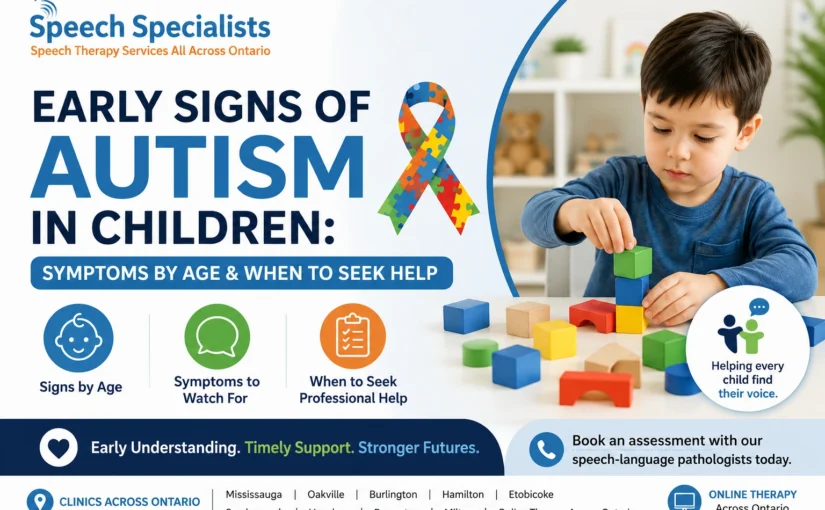
Every child develops at their own pace, but there are certain developmental milestones that help parents understand whether their child’s communication, social interaction, and behavior are progressing as expected. If you’ve ever wondered, “Does my child have autism?”, you’re not alone.
Recognizing the early signs of autism can help families access support sooner. While only a qualified healthcare professional can diagnose Autism Spectrum Disorder (ASD), understanding the warning signs allows parents to seek an assessment and begin early intervention when needed.
In this guide, we’ll explain autism symptoms by age, common communication challenges, and how speech-language therapy supports children with autism.
What Is Autism Spectrum Disorder (ASD)?
Autism Spectrum Disorder (ASD) is a neurodevelopmental condition that affects how a child communicates, interacts socially, and responds to their environment. It is called a “spectrum” because every child experiences autism differently. Some children may have mild challenges, while others require more extensive support.
Common areas affected include:
- Social communication
- Language development
- Play skills
- Behaviour and routines
- Sensory processing
- Emotional regulation
Although Speech-Language Pathologists (SLPs) do not diagnose autism, they play an important role in assessing communication skills and providing therapy that helps children build meaningful communication.
Early Signs of Autism by Age
Many early autism symptoms appear during the first two years of life. While having one sign alone does not necessarily indicate autism, a combination of several developmental differences may warrant further evaluation.
| Age | Possible Autism Signs |
|---|---|
| 6 Months | Limited eye contact, few social smiles, reduced response to faces. |
| 9 Months | Little babbling, limited facial expressions, reduced back-and-forth interaction. |
| 12 Months | Doesn’t respond to their name, limited pointing or waving, few meaningful sounds. |
| 18 Months | Few or no spoken words, limited pretend play, difficulty following simple instructions. |
| 24 Months | Not combining two-word phrases, limited social communication, repetitive speech or sounds. |
Autism Signs in Babies
Some signs of autism in babies may be noticeable before the first birthday.
These may include:
- Limited eye contact
- Rarely smiling at caregivers
- Not responding to their name
- Minimal babbling
- Little interest in social games like peek-a-boo
- Limited gestures such as pointing or waving
- Reduced imitation of sounds or facial expressions
Keep in mind that every baby develops differently. If you notice several of these behaviours consistently, speak with your pediatrician or a developmental specialist.
Autism Signs in Toddlers
As children grow, autism signs in toddlers often become more noticeable because communication and social expectations increase.
Some common signs include:
- Delayed speech or language development
- Limited interest in playing with other children
- Difficulty maintaining eye contact
- Repeating words or phrases (echolalia)
- Strong preference for routines
- Becoming upset by small changes
- Repetitive movements such as hand flapping or rocking
- Intense interest in specific objects or topics
- Limited pretend or imaginative play
These autism symptoms in children vary greatly from one child to another, so a professional evaluation is important.
Speech Delay vs Autism: What’s the Difference?
One of the most common concerns parents have is whether a speech delay automatically means autism.
The answer is no.
Children with a speech delay primarily struggle with speaking or language development, but they generally continue to:
- Make eye contact
- Enjoy social interaction
- Use gestures
- Share interests with others
- Engage in pretend play
Children with speech delay autism often experience communication challenges alongside differences in social interaction, play, and behaviour.
| Speech Delay | Autism Spectrum Disorder (ASD) |
|---|---|
| Delayed speech | Delayed speech plus social communication differences |
| Good eye contact | Limited eye contact |
| Uses gestures naturally | Limited gestures |
| Enjoys interactive play | May prefer solitary play |
| Flexible routines | Often prefers predictable routines |
Note: Only a comprehensive evaluation by a qualified healthcare professional can determine the underlying cause of your child’s communication or developmental differences.
Only a comprehensive evaluation can determine the underlying cause.
How Is Autism Diagnosed?
An autism diagnosis should only be made by qualified healthcare professionals such as:
- Developmental Pediatricians
- Clinical Psychologists
- Pediatric Neurologists
The assessment typically includes:
- Developmental history
- Parent interviews
- Observation of communication and behaviour
- Standardized developmental assessments
- Input from teachers or therapists when appropriate
Speech-Language Pathologists contribute valuable information about a child’s communication abilities but do not provide the medical diagnosis.
How Speech Therapy Helps Children with Autism
Many children with autism experience difficulties with autism communication, making speech therapy one of the most important early interventions.
A Speech-Language Pathologist may help children improve:
- Expressive language
- Receptive language
- Speech clarity
- Social communication
- Conversation skills
- Play-based communication
- Non-verbal communication
- Following directions
Because every child learns differently, autism and speech therapy programs are individualized based on each child’s strengths, interests, and developmental goals.
Autism Treatment: Why Early Intervention Matters
There is no single approach that works for every child. Effective autism treatment often involves a team of professionals working together.
Depending on your child’s needs, treatment may include:
- Speech-Language Therapy
- Occupational Therapy
- Behavioural Therapy (ABA)
- Parent coaching
- School-based supports
Research consistently shows that early intervention improves communication, learning, and social participation.
Even if your child has not yet received an autism diagnosis, beginning therapy for communication delays can still provide meaningful benefits.
What Parents in Ontario Should Do
If you’re concerned about your child’s development, don’t wait for symptoms to become more noticeable.
Parents in Ontario can:
- Discuss concerns with their family physician or pediatrician.
- Request a referral for an autism assessment if recommended.
- Book a speech and language assessment with a Speech-Language Pathologist.
- Explore publicly funded early intervention services available in Ontario.
Starting support early gives children the greatest opportunity to strengthen communication and social skills.
Frequently Asked Questions
What are the first early signs of autism?
Some of the earliest signs include limited eye contact, not responding to their name, delayed babbling, reduced gestures, and limited social interaction.
At what age can autism be detected?
Some early signs of autism may appear as early as 6 to 12 months, although many children receive a diagnosis between ages 2 and 4.
Does speech delay always mean autism?
No. Many children have isolated speech delays without autism. However, if speech delays occur alongside social communication difficulties or repetitive behaviours, further assessment is recommended.
Can speech therapy help children with autism?
Yes. Autism and speech therapy work together to improve communication, language development, social interaction, and everyday communication skills.
Should I wait for an autism diagnosis before starting therapy?
No. If your child has communication delays, speech therapy can begin before an official diagnosis. Early intervention supports development regardless of the final diagnosis.
When Should You Seek Professional Help?
Consider scheduling an evaluation if your child:
- Is not responding to their name by 12 months
- Has few or no words by 18 months
- Loses previously acquired speech or social skills
- Shows limited eye contact or social interaction
- Has repetitive behaviours alongside communication delays
- Isn’t meeting expected developmental milestones
Trust your instincts. Parents are often the first to notice subtle developmental differences.
Final Thoughts
Every child develops at their own pace, but recognizing the early signs of autism allows families to seek timely guidance and support. Early assessment and intervention can make a meaningful difference in a child’s communication, confidence, and overall development.
If you’re concerned about your child’s speech, language, or social communication, don’t wait for a diagnosis before seeking help. A Speech-Language Pathologist can assess your child’s communication skills, identify areas of need, and create a personalized therapy plan to help them reach their full potential.
At Speech Specialists, our experienced Speech-Language Pathologists provide personalized assessments and evidence-based therapy for children with autism, speech delays, language delays, and social communication challenges. We proudly serve families across Ontario through our clinics in Mississauga, Hamilton, Etobicoke, Scarborough, North York, Pickering and Milton, as well as through convenient online speech therapy services.
Need Help Choosing the Right Speech Therapy Clinic?
Speak with our team and book a speech assessment to determine the best therapy plan for your child or family member.