
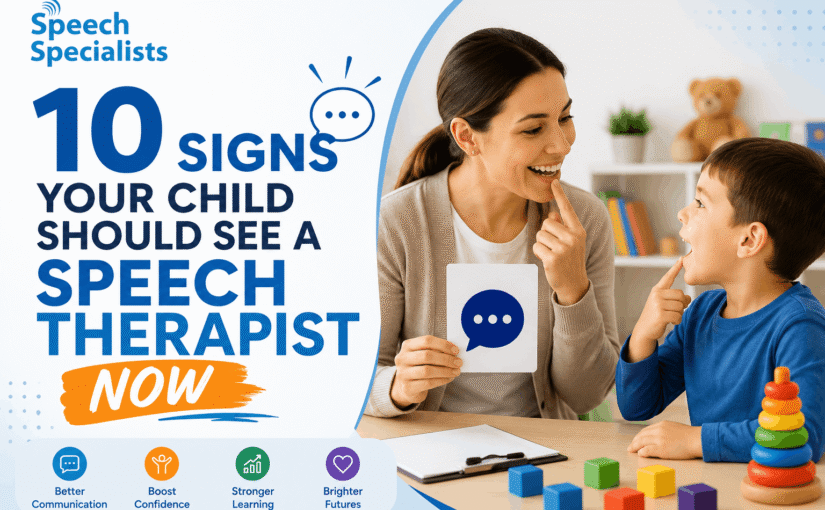
Are you concerned that your child might require speech therapy services? Do you think your child may need to see a speech therapist?
Summarize This Article With AI
Parents often ask themselves if their child’s communication problems are normal or if there is a need for professional help. All children grow at their own rate, but some speech and language problems are not to be overlooked.
When your child has trouble talking, doesn’t understand what you’re saying, is difficult to understand or is not reaching age-appropriate communication milestones, a Speech Therapy Assessment can give you answers. Early intervention is likely to result in improved outcomes and children develop the communication skills they will need for success at home, school and in social situations.
When families are looking for the best speech therapy services in Hamilton, North York, Pickering and Etobicoke, they often wonder: How can they determine whether their child needs speech therapy? The signs below can help you determine when it may be time to speak with a qualified Speech-Language Pathologist (SLP).
Why Early Speech Therapy Matters
Children’s communication skills grow quickly. These skills are involved in children’s learning, social interaction, thinking ability and confidence.
Early identification of speech or language difficulties means that children can get targeted support before difficulties start to affect their learning, social and emotional health.
If communication problems persist for a period of time, they will become more likely to impact other areas of development. This is why speech and language therapy is recommended at an early age when concerns are made.
When Should a Child See a Speech Therapist?
Parents often ask themselves if they should wait and see if their child will catch up or take the step to get help immediately. Although all children develop developmentally at their own rate, it is advisable to seek the advice of a speech therapist if your child is not reaching communication milestones, if they are not being understood, if they are having problems following instructions or if they become frustrated when they are trying to communicate.
It is also important to see a speech therapist if your child has limited vocabulary, is not using words in combination at the right level for their age, stutters often or has difficulty communicating with others. Early intervention can help recognize concerns early enough to prevent them from impacting social development, learning and confidence.
A speech therapist can assess your child’s communication skills and make suggestions that are specific to your child’s needs if you are not sure if your child’s speech and language development is on track.
Signs of Speech Delay in Toddlers
Speech delays may manifest in a variety of ways in different children. Some toddlers may be able to understand language very well but have a poor ability to express themselves, and others may have poor understanding and usage of language.
The following are signs of a speech delay in toddlers:
- Having difficulty with simple words by 12-18 months
- Delivering messages with less than the amount of words they should be able to say for their age
- Problems with stringing together two words by age two
- Limited vocabulary growth
- Poor imitation of sounds or words
- Challenge with grasping simple directions
- Using a lot of gestures rather than language
- Lacking of communication skills and frustration when attempting to communicate
Parents usually detect speech delays in their normal home environment. If your toddler exhibits more than a few of these symptoms, a speech therapy evaluation may be warranted to see if extra help is required.
1. Your child does not seem to be making progress with their speech skills.
Delayed speech development is among the most frequent speech and language concerns parents have of having their child receive speech therapy.
Though all children will progress at their own rate, the following is a list of some developmental stages:
- At approximately 12 months: Using simple word like “mama”.
- Around 2 years: Using around 20 words
- Approximately 2 years: Joining two words together
- At about 3 years: Speaking in short sentences
If your child is well below these milestones, you may want to arrange a speech therapy evaluation.
2. Your Child Is Difficult to Understand
Parents are often the most knowledgeable about their child’s speech. If family members, teachers, and/or friends often don’t understand what your child is saying, it could be a sign of an articulation disorder or speech sound disorder.
- Common examples include:
- Failing to use the sounds in words.
- Switching one sound for another.
- Unclear pronunciation
- Errors that continue after the age-appropriate level
A speech therapist can evaluate whether these patterns are developmentally appropriate or if they do need intervention.
3. Your Child Has a Limited Vocabulary
Vocabulary development is an important aspect of language development.
New words should be introduced and used by children as they mature. Language delay may be indicated if your child expresses himself or herself in much fewer words than other children of the same age or if your child has difficulty learning new words.
Children with low word recognition skills can also:
- Have difficulty communicating needs
- Increase the amount of gestures used, rather than words
- Have impatience in discussions
Early communication and language therapy can aid to build communication skills and to assist language development.
4. Your Child is having difficulty following instructions.
Speech and language problems don’t necessarily mean speaking problems.
Others children may have problems with understanding language (receptive language difficulties).
Your child might:
- Frequently misunderstands instructions
- Needs instructions to repeat several times
- Seems to lack a sense of direction when speaking
- Fails to respond to questions
Language comprehension is as crucial as language expression. During a speech-language pathologist evaluation, he/she can assess both.
5. Your Child Stutters Frequently
Repetitions are normal in some children as they are learning to speak. If a stuttering continues, however, it may need professional assistance.
Indications of concern are:
- Repeating sounds or syllables over and over
- Prolonging sounds
- Often comes across as frustrated when talking to people
Some people try to avoid talking about specific words or situations.
Speech therapy can help children learn strategies to become fluent and confident in their communication.
6. When you have trouble communicating with your child, he or she becomes frustrated.
When children are not able to communicate their thoughts and needs to others, they may feel upset.
Signs may include:
- Frequent tantrums
- Emotional outbursts
- Withdrawal from conversations
- Avoidance of social situations
Confidence and self-esteem may be impacted by communication difficulties. Early intervention helps to minimize frustration and to foster positive communication experiences.
7. Your child has trouble getting along with others.
Communication involves more than speaking clearly.
In addition to the above, children must have social communication skills to:
- Alternate speaking roles in discussions
- Maintain eye contact
- Understand social cues
- Build friendships
Challenges in these areas can be a sign of social communication challenges which can be helped by speech therapy.
Parents, teachers and/or childcare providers are likely to be the first to notice these concerns and they may be more apparent as children start school.
8. Your child has exhibited signs of a language delay.
Language delays may impact children’s comprehension and expression of language.
Common signs include:
- Difficulty answering questions
- Trouble forming sentences
- Limited vocabulary
- Challenges retelling stories
- Lack of interest in new things
Language delays can affect a child’s ability to read, write and learn without assistance.
A thorough speech therapy evaluation can provide information on areas of difficulty and can inform treatment planning.
9. There are concerns raised by teachers or Caregivers.
Children’s communication skills are observed in group settings for a great deal of time by teachers.
If a teacher, daycare provider or health care professional has recommended a speech assessment, it may be a good idea to investigate further.
They may notice:
- Learning difficulties and/or low self-esteem
- Challenges following instructions
- Poor peer interactions
- Delayed language skills
The views of professionals can be extremely helpful in understanding the impact on communication on everyday life.
10. You Have Concerns About Your Child’s Communication
One of the most important indicators is your intuition.
Parents have the most insight into their children.
If you notice that there is something unusual going on, have faith in your instincts and ask for advice from a speech therapist.
If an assessment shows that your child does not need therapy, you’ll feel good and learn more about your child’s development.
Child Not Talking Properly for Age: Should You Be Concerned?
When your child’s speech isn’t as clear or frequent as other children his or her age, it can be upsetting. Some children are quieter and/or learn to talk later than others, but if a child continues to have problems talking, it is important not to ignore it.
If your child:
- Lacks few words for their age
- Has difficulty forming sentences
- Difficult to comprehend by others
- Difficulty with basic questions
- Becomes frustrated when talking to others
If a child’s speech or language is not developing at the expected rate for their age, it could be a speech delay, language delay, articulation disorder or another communication problem. Fortunately, early speech and language therapy can provide children with the tools to develop their communication skills and boost their confidence at home and in school.
What is involved in a Speech Therapy Evaluation?
Parents are often nervous to have an assessment for fear of what will happen.
During a speech therapy assessment, a Speech-Language Pathologist will:
- Discuss developmental history
- Assess speech and language abilities
- Observe communication abilities
- Recognize strengths and challenges
- Provide recommendations
It is supportive, informative and is intended to answer your questions.
If you’ve been wondering whether your child would benefit from speech therapy, an assessment can help remove the guesswork by providing a clear understanding of their communication strengths and areas that may need support.
Also Read: Summer Speech Therapy in Ontario: Building Communication Skills Before School Starts
Benefits to early speech and language therapy
Early intervention can offer tremendous benefits to children.
Benefits may include:
- Improved speech clarity
- Stronger language skills
- Better academic readiness
- Increased confidence
- Improved social interactions
- Reduced frustration
- Improved home/school communication.
The sooner the support starts, the more positive outcomes there will be.
Conclusion
Children’s speech and language development is an important part of their development. Each child develops at their own rate, but if a child continues to have a communication difficulty, a problem should not be ignored.
When your child is delayed in speech, language, stuttering, social communication or has trouble understanding and following directions, getting help will give you guidance and peace of mind.
More families see the value of early help and action to promote their child’s communication development. A thorough speech therapy evaluation for child can help to identify concerns, strengths, and develop a plan for success.
From a speech therapy clinic in Hamilton, to a trusted speech therapy clinic in North York, a local Pickering speech therapy clinic to professional speech therapy services in Etobicoke, early assessment can be the starting point of developing better communication skills and confidence. Early help and support can have a profound impact on speech and language development.
Frequently Asked Questions:
Ques: How do I know if my child needs speech therapy?
Ans: A speech therapy evaluation could be helpful if your child has a hard time putting words together, understanding language, following directions, often stutters, or is not attaining communication milestones.
Ques: What’s the best age for a child to see a speech therapist?
Ans: Speech therapy can help kids of any age. Many parents want assessments to be performed when toddlers and preschoolers begin to have more noticeable delays in speech and language.
Ques: Does a speech delay ever go away?
Ans: Some children recover on their own, others need professional assistance. A speech-language pathologist will be able to decide if intervention is needed.
Ques: What are the differences between speech delay and language delay?
Ans: Speech delay relates to the production of sounds and words, and language delay relates to the comprehension and use of language.
Ques: When will speech therapy be completed?
Ans: Treatment will be tailored to each child’s needs, goals, and progress, and may last for different durations. For some kids, a short-term program is enough; for others, continued therapy is helpful.
Ques: Is speech therapy covered by insurance?
Ans: Several long-term insurance policies include coverage for speech therapy. Coverage may differ by company and coverage policy.
Need Help Choosing the Right Speech Therapy Clinic?
Speak with our team and book a speech assessment to determine the best therapy plan for your child or family member.