What Age Should a Child Start Speech Therapy? A Hamilton Parent’s Guide

Quick Answer

Early speech therapy intervention is best when initiated as early as possible once you notice your child is having difficulty with speech, language or communication. Help can be sought at any age. An assessment may be indicated for children as early as 18-24 months if they are not developing at expected communication levels. Children’s speech, language, social communication and confidence can be enhanced before they begin school by early interventions.

Introduction

One of the most frequently asked questions parents have is:

When should speech therapy begin?

As a parent, your concern is whether it’s best to wait or intervene if your toddler isn’t talking as well as other children, your preschooler is hard to understand or your child has trouble following simple instructions.

Fortunately, it is not too late to get answers until your child begins school.

Children acquire their speech and language skills from the moment they are born and they learn to communicate on a daily basis using sounds, gestures, words, play and with their family. Early support can make a difference when communication doesn’t go the way it should.

Many parents feel that their child may be a “late talker” and that they will “catch up” with his own. Some children make progress without intervention; for others, it is very helpful to have a qualified speech and language therapist to notice early on the difficulties and offer strategies that work for them.

One of the first steps for families seeking speech therapy in Hamilton is to understand when it’s the right time to seek assistance. Assessments at an early age can offer reassurance, guidance and – if necessary – a therapy plan tailored to your child’s needs if they have a speech delay, language delay, are struggling with word pronunciation or are having difficulties expressing themselves.

In this guide, you’ll learn:

  • What age children can start speech therapy
  • Typical speech and language milestones by age
  • Signs your child may need speech therapy
  • Why early intervention matters
  • What happens during a speech assessment
  • How families in Hamilton can access professional speech therapy services

Keep in mind that each child is unique in his or her development. This guide is meant to help you understand the expectations for each age, and not to compare your child with others.

When is the best time for a child to begin speech therapy?

There isn’t a single “perfect” age for speech therapy.

Instead, the right time depends on your child’s communication skills and developmental milestones rather than their birthday.

Children can benefit from speech therapy as early as infancy if feeding or oral motor concerns are present. For speech and language development, many children are referred between 18 months and 3 years of age, especially if they are not meeting expected communication milestones.

The most important point to keep in mind:

When in doubt about your child’s communication, it is never too late to seek advice from a professional.

A speech-language assessment doesn’t automatically mean your child will need therapy. Often parents only receive reassurance, home strategies or guidance on monitoring progress.

But, when support is recommended, early intervention can help children learn to communicate before difficulties start to impact on learning, friendships and confidence.

Does a 2 year old need speech therapy?

No.

Two years old is not too early for speech therapy.

By around two years of age, many children are beginning to:

  • Express commands with two word phrases like “more milk” or “Daddy home.
  • Follow simple instructions.
  • Use pointing when naming familiar objects.
  • Ask for favourite toys or foods.
  • Understand everyday routines.
  • Learn new words rapidly.

If your child has very few words, struggles to communicate their needs, or rarely attempts to imitate sounds, a speech-language assessment can help determine whether they would benefit from additional support.

Early intervention in the toddler years is at a time when children’s brains are developing language skills quickly.

Is 3 Years Old a Good Age to Start Speech Therapy?

Absolutely.

A common age for children to start speech therapy is three years.

At this age, children should be able to communicate more readily and to have longer sentences in their daily speech.

Many three-year-olds can:

  • Speak in short sentences.
  • Ask simple questions.
  • Follow two-step directions.
  • Communicate to adults what they want.
  • Participate in conversations.
  • Play and communicate with other children.

If your child has speech issues that are hard for unfamiliar people to understand or if your child has trouble expressing themselves, speech therapy could help build your child’s communication skills before they start preschool or kindergarten.

Also Read: Kindergarten Readiness Checklist: Is Your Child Ready for Kindergarten? (Parent’s Guide)

Is 4 or 5 Years Old Too Late?

Not at all.

Children often start speech therapy when they’re preschoolers.

Parents are actually more aware of communication problems as kids are getting ready for kindergarten.

By the ages of 4 and 5 children should:

  • Be verbally clear and articulate enough to be understood by most.
  • Tell stories using several connected sentences.
  • Answer “who, what, where and why” questions.
  • Follow classroom directions.
  • Participate confidently in conversations.
  • Take part in play with others.

If these skills are still developing, speech therapy can provide targeted support before school begins.

There are many families in Hamilton that opt to have their child see a speech and language therapist in the months preceding kindergarten so they can grow in confidence before starting school.

Why Early Speech Therapy Matters

Parents sometimes wonder whether they should “wait and see” if their child’s speech improves naturally.

Early intervention focuses on helping children develop the skills they need while their brains are rapidly growing and learning.

Research has consistently shown that children often make excellent progress when communication challenges are identified and addressed early.

The early speech therapy can assist children to:

  • Be more expressive in their ideas and emotions.
  • Develop a wider range of vocabulary.
  • Improve speech clarity.
  • Follow directions more readily.
  • Improve social communication ability.
  • Become more confident in communications with adults and other children.
  • Prepare for success in preschool and kindergarten.

More importantly, early intervention can help to minimize frustration.

Many children get upset when they have something they want to say, but they can’t effectively express it. Development of communication skills can enhance speech and language as well as confidence levels and participation in normal activities.

Speech and Language Milestones by Age

Each child grows at his or her own rate but speech and language milestones offer a useful reference to see what many children can achieve at various ages.

The following milestones are not rules, but are general expectations.

Birth to 12 Months

Communication starts long before children start speaking; in the first year of life.

Many babies:

  • Be happy and look in someone’s eyes.
  • Make “ba-ba” and “da-da” sounds.
  • Turn toward sounds.
  • Answer to their name.
  • Use simple words such as “mama” and “dada” around their first birthday.

If your baby is not responding to sounds, not babbling or has limited interaction with others, it is important to talk to your health care provider about your concerns.

12 to 24 Months

Second year: Language development is very rapid.

By the time they are toddlers, many kids start to:

  • Use at least 50 words by around age two.
  • Combine two words into short phrases.
  • Follow simple directions.
  • Identify familiar objects.
  • Point to pictures in books.
  • Enjoy songs and nursery rhymes.
  • Learn new words every week.

An early speech-language assessment may be useful for children with limited vocabulary or those who are having difficulty understanding simple language.

2 to 3 Years

Children tend to talk more during this period (ages two to three).

Many children can:

  • Use short sentences.
  • Ask simple questions.
  • Name familiar objects.
  • Follow two-step instructions.
  • Discuss everyday events.
  • Join in basic dialogue.
  • Be understood by familiar adults, most of the time.

It’s also the age when parents first look for a Hamilton child speech therapist if they feel like their child isn’t communicating as they might expect.

Speech and Language Milestones (3–5 Years)

Children’s communications skills develop very quickly as they get closer to preschool and kindergarten. They start to join in conversations with family, teacher, and friends, and start to use longer sentences, ask more questions.

These are general indicators to help parents understand their child’s development, although all children develop at their own rate.

3 to 4 Years

By the time a child is 3-4 years old, many can:

  • Use sentences that contain 4-6 words.
  • Ask and respond to basic questions.
  • Share story of the day.
  • Follow two- and three-step directions.
  • Develop an awareness of terms such as big/small, in/on, first/last.
  • Name common colours and shapes.

If your child is still hard to understand or having trouble expressing their ideas, it may be worthwhile to make a speech and language assessment appointment.

4 to 5 Years

Children are able to do the following before kindergarten:

  • Speak in complete, well-structured sentences.
  • Retell simple stories in sequence.
  • Ask “why,” “how,” and “when” questions.
  • Understand classroom directions.
  • Participate in group conversations.
  • Use a growing vocabulary.
  • Pronounce most speech sounds clearly.
  • Express ideas, emotions, and experiences confidently.

These communication skills enable children to be involved in classroom discussions, make friends and develop early literacy skills.

Early support may help make school a much smoother transition if your child is still struggling in these areas.

Signs Your Child May Need Speech Therapy

Many parents might ask themselves if their child is just progressing in their own way or if it’s time to have professional help.

Although only a qualified speech-language pathologist can evaluate your child’s communication skills, there are a number of indicators that may warrant an evaluation.

Your Child May Benefit from Speech Therapy If They:

  • Have fewer words than expected for their age.
  • Become frustrated when trying to communicate.
  • Does not often use words to form sentences.
  • Have trouble following simple directions.
  • Don’t answer basic questions.
  • Has difficulty saying many speech sounds.
  • Do not communicate with other children as communication is difficult.

Keep in mind that if your child exhibits one of these signs, it does not automatically mean that he or she has a speech or language disorder.

An assessment, however, can be used to determine whether your child’s communication is developing normally or if there may be a need to provide extra support.

What Happens During a Speech Assessment?

Parents’ top concern is what to expect at an assessment.

Fortunately, assessments of speech and language are made child-friendly, age-appropriate and engaging.

The assessment is not a school exam, but more a game, conversation, play-based activity, book and interactive activity.

An Speech-Language Pathologist can evaluate your child’s:

  • Speech clarity
  • Language understanding
  • Vocabulary
  • Sentence structure
  • Social communication
  • Listening skills
  • Play skills
  • Oral motor development
  • Overall communication abilities

Parents are also encouraged to share their observations, concerns, and questions throughout the appointment.

After the assessment, you’ll receive professional recommendations based on your child’s individual strengths and needs.

These suggestions could involve:

  • Monitoring development
  • Home practice strategies
  • Short-term therapy
  • Speech and Language intervention that continues throughout the academic year

Not every child who has an assessment requires regular therapy. Sometimes parents just receive reassurance and practical tips to help them at home.

Searching for the right Speech Therapist in Hamilton.

Selecting the right speech-language pathologist is an important family decision.

If you’re searching for speech therapy in Hamilton, look for a clinic that offers:

  1. Evidence-based assessment and treatment.
  2. Family-centred care.
  3. Individualized therapy plans.
  4. Age-appropriate, play-based sessions.
  5. Effective communication with parents.
  6. Have experience working with toddlers, preschool and school aged children.

The best therapy isn’t to just improve children’s ability to say words clearly—it’s to help children say them confidently in daily life.

It could be asking a teacher for help, participating in a class discussion or speaking about their ideas at home – communication skills can contribute to success outside the therapy room.

Need Help Choosing the Right Speech Therapy Clinic?

Speak with our team and book a speech assessment to determine the best therapy plan for your child or family member.

Frequently Asked Questions

When is a good age to begin speech therapy?

Speech therapy can start from 18-24 months if there are concerns about speech, language and/or communication skills. No minimum age for seeking professional advice and early intervention is often the most effective intervention.

Is my child too young to be in speech?

No.

It’s never too late to have your child assessed if you are worried about their communication. Even if toddlers don’t need therapy, some benefit from early guidance.

Do I need to wait and see if my child will catch up?

Some children catch up with their peers naturally, others need professional support.

Instead of waiting and worrying, have your child’s communication skills evaluated by a Speech-Language Pathologist. Good information and decision making comes from an assessment.

How long does speech therapy take?

Therapy can last for a variety of reasons, such as:

  • Your child’s age.
  • The type of communication difficulty.
  • The difficulty level of the challenge.
  • The regularity with which strategies are implemented at home.
  • Individual learning pace.

Some children reach their objectives in a few months, others in a longer period of time.

Can speech therapy help before kindergarten?

Yes.

Many families decide to start speech therapy as early as before kindergarten to increase communication, language and social skills.

Children can benefit from beginning their education early:

  • Follow classroom directions.
  • Communicate with teachers.
  • Build friendships.
  • Participate confidently in learning activities.

Final Thoughts

So if you have been wondering, “What age should a kid begin speech therapy?” then it is quite easy to answer that question.

The optimum time is when you first become concerned, not after months of waiting and wondering.

Early support provides children with the chance to develop essential communication skills when it is at a critical time in their development.

If your child is just starting to talk, is having trouble saying words, is not comprehending language or has trouble communicating with others, taking professional help is a good decision.

Remember:

  1. All children progress at their own level.
  2. An assessment doesn’t necessarily mean that therapy is required.
  3. Early intervention can enhance confidence, communication and school readiness.
  4. Parents don’t have to deal with communication problems themselves.

Make an appointment for a Speech and Language Assessment in Hamilton

Speech Specialists is a team of experienced speech and language specialists ready to assist you if you are worried about your child’s speech or language development.

Speech-Language Pathologists conduct thorough evaluations and individualized therapy for infants, toddlers, preschoolers, school-aged children and adults.

We are trusted by families throughout Hamilton, including Ancaster, Dundas, Stoney Creek, Waterdown, Mount Hope, and Binbrook, to provide caring, research-informed speech therapy services that support communication at every stage of life.

If you’re concerned about whether your toddler is a “late talker,” getting ready for kindergarten or want advice on speech milestones, we’ll have the answers for you and develop a plan that fits your family’s needs.

Schedule a speech and language evaluation now and empower your child to develop the communication abilities that will support him or her to succeed at home, in school, and in life.
Kindergarten Readiness Checklist: Is Your Child Ready for Kindergarten? (Parent’s Guide)

Summarize This Article With AI

Starting kindergarten is one of the biggest milestones in a child’s life—and one of the most emotional moments for parents. As the first day of school approaches, many parents begin asking the same questions:

  • Is my child ready for kindergarten?
  • What should my child know before kindergarten?
  • How can I prepare my child for kindergarten during the summer?
  • Do they have the communication skills they need to succeed in the classroom?

If you’ve found yourself asking these questions, you’re not alone.

Every year, thousands of parents search for a kindergarten readiness checklist to understand whether their child is prepared for this exciting transition. While it’s natural to focus on academic skills like recognizing letters, counting numbers, or writing their name, research and educators consistently emphasize that school readiness goes far beyond academics.

Children who are ready for kindergarten are typically able to:

  • Communicate their thoughts and needs clearly.
  • Understand and follow classroom instructions.
  • Interact with teachers and classmates.
  • Participate in group activities.
  • Solve simple problems independently.
  • Manage basic self-care routines.

These everyday skills help children feel confident, build friendships, and enjoy learning from the very beginning.

The good news is that kindergarten readiness isn’t about being perfect. Every child develops at their own pace, and many important skills continue to grow throughout the school year. The goal isn’t to compare your child with others—it’s to identify strengths, recognize areas where they may need additional support, and give them the best possible start.

In this comprehensive guide, you’ll learn:

  • What kindergarten readiness really means
  • The most important kindergarten readiness skills
  • A practical school readiness checklist
  • What children should know before kindergarten
  • How to prepare your child for kindergarten over the summer
  • Signs that your child may benefit from extra support before school starts

Whether your child is excited about school or feeling a little nervous, these tips will help you approach the transition with confidence.

What Does “Kindergarten Ready” Really Mean?

When parents hear the phrase “kindergarten ready,” they often think about academic abilities.

  • Can my child count to 20?
  • Do they know the alphabet?
  • Can they write their name?

While these skills are certainly helpful, they represent only a small part of what schools consider kindergarten readiness.

In reality, kindergarten readiness refers to a child’s overall ability to participate successfully in a classroom environment. This includes communication, language, social-emotional development, independence, attention, and early learning skills.

Think of school readiness as a combination of several building blocks that work together.

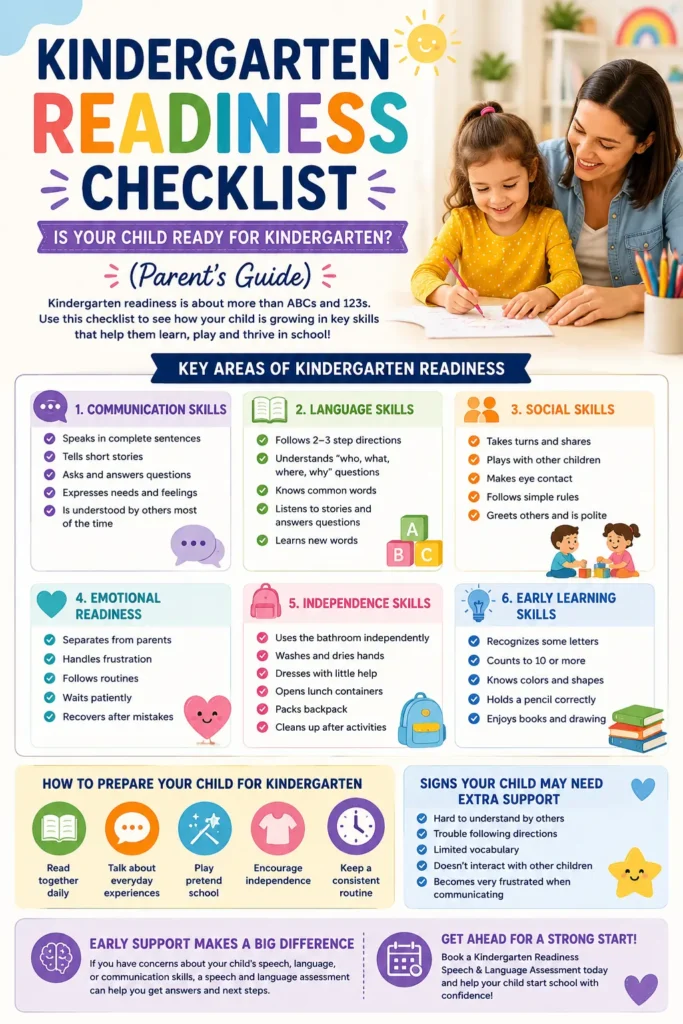
Kindergarten Readiness Checklist

Communication Skills

Children need to communicate with teachers and classmates throughout the day.

For example, they should be able to:

  • Ask for help when they need it.
  • Express their thoughts and feelings.
  • Tell a teacher if something is wrong.
  • Answer simple questions.
  • Participate in classroom discussions.

Strong communication skills help children feel confident and reduce frustration when they encounter new situations.

Language Skills

Language is more than speaking words.

Children also need to understand what other people are saying.

This includes:

  • Following classroom directions.
  • Understanding questions.
  • Learning new vocabulary.
  • Listening during story time.
  • Understanding routines and expectations.

Language skills form the foundation for reading, writing, and learning across every subject.

Social Skills

Kindergarten introduces children to a much larger social environment than many have experienced before.

Being socially ready means they can:

  • Take turns.
  • Share with classmates.
  • Play cooperatively.
  • Make simple conversations.
  • Respect personal space.
  • Solve small disagreements with support.

Children don’t need to be outgoing—they simply need basic skills that help them connect with others.

Emotional Readiness

Every child experiences excitement, nervousness, disappointment, and frustration.

Kindergarten readiness includes learning how to manage these emotions appropriately.

Examples include:

  • Separating from parents without prolonged distress.
  • Waiting patiently for their turn.
  • Coping when they don’t win a game.
  • Following classroom routines.
  • Recovering after making mistakes.

These emotional skills help children adjust more easily to a structured school environment.

Independence Skills

Teachers care just as much about independence as they do about academic knowledge.

Children should gradually learn how to:

  • Wash their hands.
  • Use the bathroom independently.
  • Put on their shoes or jacket.
  • Open lunch containers.
  • Pack their backpack.
  • Clean up after activities.

Developing independence builds confidence and allows teachers to focus more on learning.

Attention and Listening Skills

Kindergarten classrooms involve group instruction, storytelling, games, and learning activities that require children to pay attention.

Being able to:

  • Listen to directions
  • Stay focused for short periods
  • Follow two- or three-step instructions
  • Complete simple activities

helps children participate successfully in daily classroom routines.

Every Child Develops at Their Own Pace

One of the biggest misconceptions about kindergarten readiness is that every child should reach the same milestones at exactly the same time.

In reality, children develop at different rates.

Some children begin speaking in full sentences very early, while others develop these skills closer to age five.

Some naturally enjoy social interactions, while others need more time to build confidence.

Development is not a race.

Instead of comparing your child to friends, siblings, or classmates, it’s more helpful to ask:

Can my child communicate, learn, and participate in everyday classroom activities with growing confidence?

If the answer is “mostly yes,” they’re likely on the right path.

If you’re unsure about specific areas—particularly speech, language, or communication—early support can make a meaningful difference before school begins.

Is My Child Ready for Kindergarten?

This is one of the most common questions parents ask before the school year starts.

The truth is, there isn’t a single test that determines whether a child is ready for kindergarten.

Instead, teachers and child development professionals look at a combination of skills across several developmental areas.

A child doesn’t need to master every skill perfectly before their first day of school.

Instead, they should demonstrate a growing ability to learn, communicate, interact with others, and adapt to new routines.

Here are some questions you can ask yourself.

Can My Child Communicate Their Needs?

One of the biggest adjustments children make in kindergarten is spending several hours away from their parents.

During this time, they need to communicate independently.

Ask yourself:

  • Can my child tell an adult when they need help?
  • Can they ask to use the bathroom?
  • Can they explain if they’re hurt or feeling unwell?
  • Can they express basic emotions like happy, sad, angry, or scared?
  • Can they ask questions when they’re confused?

Children don’t need perfect grammar or pronunciation, but they should be able to make themselves understood most of the time.

Also Read: How to Choose the Right Speech Therapy Clinic for Your Family

Can My Child Follow Simple Instructions?

Teachers give directions throughout the school day.

Examples include:

  • Put your backpack away.
  • Wash your hands before snack.
  • Sit on the carpet.
  • Line up at the door.
  • Put your crayons back in the box.

Children who can follow one-, two-, and eventually three-step directions generally adapt more smoothly to classroom routines.

If your child frequently seems confused, forgets directions, or needs repeated reminders, they may benefit from extra practice at home.

Can My Child Interact With Other Children?

Kindergarten is filled with opportunities to learn through play.

Children don’t need to have dozens of friends before school starts.

However, they should begin developing basic social communication skills.

These include:

  • Greeting other children.
  • Taking turns.
  • Sharing toys.
  • Asking to join a game.
  • Listening while others speak.
  • Using words instead of physical behaviour to solve problems.

These everyday interactions help children feel included and build positive relationships with classmates.

Can My Child Listen During Activities?

Teachers often read stories, explain activities, and give group instructions.

Ask yourself:

  • Can my child sit and listen to a short story?
  • Can they stay engaged for 10–15 minutes during an activity?
  • Can they answer simple questions about what they heard?
  • Can they transition from one activity to another with support?

Listening is one of the most important foundations for classroom learning.

Can My Child Manage Simple Daily Tasks?

Kindergarten encourages children to become more independent.

Before school begins, it’s helpful if your child can:

  • Put on their backpack.
  • Open their lunch container.
  • Wash and dry their hands.
  • Use the bathroom independently.
  • Put away toys after playtime.

These skills help children feel capable and confident throughout the school day.

Remember: Readiness Is About Progress, Not Perfection

Many parents worry that their child isn’t “ready enough.”

The reality is that kindergarten is designed to help children grow. Your child doesn’t need to know everything before the first day of school. What matters most is their willingness to learn, communicate, and participate in everyday classroom experiences.

If you notice challenges with communication, understanding directions, or interacting with others, identifying these areas early gives your child more time to build confidence before school begins.

Kindergarten Readiness Checklist

The easiest way to understand whether your child is prepared for kindergarten is to look at everyday skills rather than academic achievements alone.

Use the kindergarten readiness checklist below as a practical guide. Remember, this isn’t a pass-or-fail test. Instead, it helps you identify your child’s strengths and areas where they may benefit from additional practice before school starts.

Communication Skills Checklist

Communication is one of the strongest predictors of classroom success. Children who can express themselves clearly are better able to ask for help, participate in learning, and build relationships with teachers and classmates.

Before starting kindergarten, many children can:

  1. Speak in simple, complete sentences.
  2. Tell an adult what they need or want.
  3. Answer basic questions about themselves.
  4. Ask simple questions when they’re unsure.
  5. Share experiences using several connected sentences.
  6. Tell a short story about something that happened during their day.
  7. Use words instead of gestures most of the time.
  8. Take turns during conversations.
  9. Make eye contact while speaking and listening.
  10. Be understood by familiar adults most of the time.

Parent Tip: If your child often becomes frustrated because others don’t understand them or has difficulty expressing their thoughts, consider discussing your concerns with a speech-language pathologist before the school year begins.

Now that you’ve reviewed your child’s communication skills, let’s look at other important areas that help children feel confident and successful in kindergarten.

Remember, this school readiness checklist isn’t about achieving perfection. Instead, it helps you identify opportunities to build your child’s confidence before the first day of school.

Language Skills Checklist

While communication focuses on expressing thoughts, language skills involve understanding what others say, processing information, and responding appropriately.

These skills play a significant role in learning, following classroom routines, and participating in daily activities.

Before kindergarten, many children are able to:

  1. Follow two-step directions such as, “Put your backpack away and sit on the carpet.”
  2. Understand simple “who,” “what,” “where,” “when,” and beginning “why” questions.
  3. Listen to a short story and answer basic questions about it.
  4. Identify common colours, shapes, and everyday objects.
  5. Name familiar family members, pets, and friends.
  6. Understand classroom vocabulary such as line up, circle time, snack, clean up, and recess.

Why Language Skills Matter

Imagine a teacher saying:

“Take out your crayons, colour the picture, and then place it in your cubby.”

A child who understands language well can complete the activity independently.

A child with language difficulties may appear distracted or inattentive when, in reality, they simply didn’t understand the instructions.

Strong language skills support nearly every part of classroom learning, including:

  • Listening to teachers
  • Following routines
  • Learning new concepts
  • Reading readiness
  • Early writing
  • Problem-solving
  • Building friendships

Parent Tip

One of the easiest ways to strengthen language development is through everyday conversation.

Instead of asking questions with one-word answers like:

“Did you have fun?”

Try open-ended questions such as:

  • “What was your favourite part of today?”
  • “Tell me about the game you played.”
  • “Why do you think that happened?”
  • “What would you do differently next time?”

These conversations naturally build vocabulary, sentence structure, and critical thinking.

Social Skills Checklist

Kindergarten is often a child’s first experience spending several hours each day with a large group of peers.

Being able to interact with others respectfully and confidently is one of the most important kindergarten readiness skills.

Many kindergarten-ready children can:

  1. Take turns during games.
  2. Share toys and classroom materials.
  3. Wait patiently for short periods.
  4. Introduce themselves to another child.
  5. Ask to join a game politely.
  6. Play cooperatively with other children.
  7. Listen while someone else is talking.
  8. Accept losing a game without becoming overly upset.
  9. Say “please,” “thank you,” and “excuse me.”

Why Social Skills Are Important

Many parents worry that their child doesn’t know enough letters or numbers.

However, teachers often say that social skills have a greater impact during the first few weeks of kindergarten.

Children spend much of the day:

  • Working in groups
  • Playing together
  • Sharing classroom supplies
  • Waiting their turn
  • Listening to classmates
  • Solving small disagreements

These experiences help children develop friendships and enjoy learning.

What If My Child Is Shy?

Shyness doesn’t automatically mean a child isn’t ready for kindergarten.

Some children naturally observe before joining activities.

This is perfectly normal.

Instead of focusing on making your child more outgoing, encourage them to:

  • Greet new people.
  • Practice introducing themselves.
  • Ask simple questions.
  • Order their own food at a restaurant.
  • Speak to cashiers or librarians.
  • Play with children at parks.

Confidence grows with practice—not pressure.

Emotional Readiness Checklist

Starting school brings many new experiences. Children may feel excited one moment and nervous the next. Emotional readiness helps children cope with these changes. Before kindergarten, many children can:

  1. Separate from parents without prolonged distress.
  2. Recover after becoming upset.
  3. Handle small disappointments.
  4. Express emotions using words.
  5. Wait for a preferred activity.
  6. Follow daily routines.

Why Emotional Readiness Matters

Maybe they lose a game.

Maybe they make a mistake during an activity.

Children who are learning emotional regulation can:

  • Stay calmer.
  • Recover more quickly.
  • Continue participating.
  • Learn from mistakes.
  • Develop resilience.

These skills support both learning and friendships.

Helping Your Child Build Emotional Confidence

Parents can strengthen emotional development by:

  • Naming emotions during everyday situations.
  • Reading books about feelings.
  • Practicing deep breathing together.
  • Creating predictable routines.
  • Celebrating effort instead of perfection.
  • Encouraging problem-solving rather than solving every problem for them.

Simple daily experiences often teach emotional skills more effectively than formal lessons.

Independence Skills Checklist

One question many parents ask is:

“What should my child know before kindergarten?”

The answer often surprises them.

Teachers spend much less time teaching children how to count than helping them become independent.

Before starting kindergarten, many children can:

  1. Wash and dry their hands independently.
  2. Use the bathroom without assistance.
  3. Put on their coat.
  4. Zip or button simple clothing.
  5. Put on shoes.
  6. Open lunch containers.
  7. Use a water bottle independently.
  8. Pack their backpack.
  9. Clean up after activities.

Why Independence Builds Confidence

Imagine trying to open your lunch container while everyone else has already started eating. Or needing help putting on your coat every time the class goes outside. These situations can make children feel frustrated or embarrassed.

Teaching independence before school helps children:

  • Feel confident.
  • Solve small problems.
  • Develop responsibility.
  • Participate more independently throughout the day.

Read More: 10 Signs Your Child Should See a Speech Therapist Now

Practice Makes Progress

The summer before kindergarten is the perfect time to practice everyday routines.

Allow extra time for your child to:

  • Dress themselves.
  • Pack their own backpack.
  • Carry their lunch.
  • Put away toys.
  • Help prepare simple snacks.
  • Organize school supplies.

These activities may take longer initially, but they build lifelong independence.

Kindergarten Readiness Skills That Matter Most

When parents think about preparing for school, they often focus on academic milestones. But experienced educators know that successful kindergarten students rely on a much broader set of skills.

Here are the kindergarten readiness skills that truly make a difference.

1. Communication

Children should feel comfortable expressing:

  • Needs
  • Feelings
  • Questions
  • Ideas

Communication supports every classroom interaction.

2. Listening

Listening is essential for:

  • Following directions
  • Participating in lessons
  • Learning new information
  • Staying safe

Good listeners often transition more smoothly into school routines.

3. Following Directions

Teachers regularly give instructions involving multiple steps.

Examples include:

  • Put your folder away.
  • Wash your hands.
  • Sit at your table.
  • Choose a book.

Children who can follow directions independently often gain confidence quickly.

4. Social Interaction

Positive peer relationships make school more enjoyable.

Important skills include:

  • Sharing
  • Taking turns
  • Greeting others
  • Solving simple disagreements
  • Working in groups

5. Problem Solving

Children don’t need all the answers. Instead, they should begin learning how to think through simple situations.

Examples include:

  • Asking for help.
  • Trying another solution.
  • Looking for missing items.
  • Using words to solve conflicts.

6. Curiosity

One of the strongest indicators of future learning is curiosity.

Encourage children to:

  • Ask questions.
  • Explore nature.
  • Build with blocks.
  • Read books.
  • Experiment during play.

Curious children become enthusiastic learners.

7. Confidence

Confidence isn’t about knowing everything. It’s about being willing to try.

Children who believe:

  1. “I can learn.”
  2. “I can ask for help.”
  3. “I can keep trying.”

often adapt more successfully to kindergarten.

What Should My Child Know Before Kindergarten?

Parents frequently ask this question expecting a list of academic skills.

The reality is much broader.

Here’s a simple overview of what many children know or are beginning to develop before kindergarten.

Communication

Many children can:

  • Speak in complete sentences.
  • Ask for help.
  • Answer questions.
  • Tell short stories.
  • Explain simple ideas.

Language

Many children can:

  • Follow two- and three-step directions.
  • Understand everyday vocabulary.
  • Listen to stories.
  • Answer questions about what they heard.
  • Learn new words quickly.

Social Skills

Many children can:

  • Play with peers.
  • Share materials.
  • Wait for turns.
  • Follow classroom rules.
  • Join group activities.

Self-Help Skills

Many children can:

  • Dress with minimal assistance.
  • Wash hands.
  • Use the bathroom independently.
  • Open lunch containers.
  • Carry their belongings.

Early Learning Skills

Children are often beginning to:

  • Recognize some letters.
  • Count simple objects.
  • Identify colours and shapes.
  • Hold a pencil correctly.
  • Enjoy books.
  • Draw simple pictures.
  • Write some letters in their name.

Remember, these academic skills develop throughout kindergarten.

Teachers understand that children enter school with different experiences and abilities.

How to Prepare Your Child for Kindergarten Over the Summer

The weeks before kindergarten are one of the best opportunities to help your child build confidence—not through worksheets, but through meaningful everyday experiences.

Here are practical ways to prepare your child for kindergarten at home.

Read Together Every Day

Reading aloud strengthens:

  • Vocabulary
  • Listening skills
  • Attention
  • Imagination
  • Early literacy

Ask questions while reading, such as:

  • “What do you think will happen next?”
  • “Why is the character feeling sad?”
  • “What would you do?”

Practice Everyday Conversations

Encourage your child to tell you about:

  • Their favourite part of the day
  • A game they played
  • Something funny they noticed
  • A problem they solved

Longer conversations help develop expressive language and confidence.

Play Pretend School

Role-playing classroom routines can reduce anxiety.

Practice:

  • Greeting the teacher
  • Sitting for story time
  • Raising a hand
  • Packing a backpack
  • Eating lunch independently

Pretend play helps children know what to expect on their first day.

Encourage Independence

Allow your child to:

  • Dress themselves
  • Pack their lunch
  • Choose clothes
  • Clean up toys
  • Carry their backpack

These simple routines build confidence and responsibility.

Visit the School

If possible:

  • Walk around the playground.
  • Visit the school building.
  • Show them where they’ll enter.
  • Talk positively about kindergarten.

Familiar surroundings often reduce first-day anxiety.

Limit Screen Time and Increase Real Conversations

Children learn communication through interaction—not passive screen use.

Instead of extra screen time, spend time:

  • Playing board games
  • Building with blocks
  • Reading books
  • Cooking together
  • Exploring outdoors

These everyday activities naturally strengthen language, problem-solving, and social skills.

Keep a Predictable Routine

A few weeks before school begins:

  • Adjust bedtime gradually.
  • Practice waking up earlier.
  • Eat meals at regular times.
  • Follow a simple daily schedule.

Predictable routines make the transition to kindergarten much smoother.

Signs Your Child May Need Extra Support Before School Starts

Every child develops at their own pace, and it’s completely normal for children to have different strengths and challenges. Some children may be confident socially but need support with communication, while others may have excellent vocabulary but struggle to interact with peers.

The purpose of this guide isn’t to make parents worry—it’s to help you recognize when your child may benefit from additional support before starting kindergarten.

Many communication challenges respond well to early intervention, and addressing them before school starts can help children enter the classroom with greater confidence.

Communication Signs to Watch For

Consider seeking professional advice if your child:

  • Is difficult for unfamiliar adults to understand.
  • Uses very short sentences compared to children of a similar age.
  • Has trouble telling you about their day.
  • Rarely asks questions.

These signs don’t automatically mean your child has a speech or language disorder, but they do indicate that an evaluation may be helpful.

Language Signs to Watch For

Children entering kindergarten are expected to understand increasingly complex language throughout the school day.

You may want to speak with a speech-language pathologist if your child:

  • Has difficulty following two-step directions.
  • Rarely answers “who,” “what,” “where,” or “why” questions.
  • Needs repeated explanations.
  • Has a noticeably smaller vocabulary than peers.
  • Struggles to understand simple stories.

Strong language skills are essential because children spend much of their school day listening to teachers, participating in discussions, and learning new concepts.

Social Communication Signs

Communication isn’t only about speaking clearly—it’s also about connecting with other people.

You may notice challenges if your child:

  • Rarely starts conversations.
  • Doesn’t respond consistently when spoken to.
  • Avoids playing with other children.
  • Finds it difficult to take turns during conversations.
  • Doesn’t make eye contact naturally.
  • Has trouble understanding social rules during play.

Developing these skills before kindergarten can make making friends and participating in classroom activities much easier.

Speech Sound Concerns

Many speech sound errors are part of typical development. However, if your child’s speech is difficult for people outside the family to understand, it may be worth seeking advice.

Examples include:

  • Frequently leaving sounds out of words.
  • Replacing many sounds with easier ones.
  • Speaking in a way that teachers or other adults may struggle to understand.
  • Becoming upset when others ask them to repeat themselves.

Improving speech clarity before school begins can help children participate more confidently in classroom discussions and social interactions.

Attention and Listening Concerns

Children don’t need to sit perfectly still all day, but they should gradually develop the ability to participate in structured activities.

You may notice challenges if your child:

  • Rarely completes simple activities.
  • Has difficulty listening to short stories.
  • Frequently misses important instructions.
  • Appears to “tune out” during conversations.
  • Needs constant reminders to complete simple tasks.

Sometimes these behaviours are related to communication or language difficulties rather than attention alone.

Trust Your Instincts as a Parent

Parents are often the first to notice when something doesn’t seem quite right.

If you’ve been asking yourself questions like:

  1. “Is my child ready for kindergarten?”
  2. “Should my child be talking more?”
  3. “Why is my child difficult to understand?”
  4. “Will they struggle once school starts?”

it’s worth discussing your concerns with a qualified speech-language pathologist.

Seeking advice doesn’t mean something is “wrong.” It simply provides clarity and helps you understand whether your child’s communication skills are developing as expected.

When Should You Consider a Speech and Language Assessment?

Many parents assume speech therapy is only necessary for children with significant communication difficulties.

In reality, speech and language assessments can benefit children with mild concerns as well.

Early support often helps children:

  • Build confidence before starting school.
  • Develop stronger communication skills.
  • Follow classroom instructions more easily.
  • Participate in group learning.
  • Make friends more comfortably.
  • Reduce frustration when communicating.

The earlier communication challenges are identified, the more opportunities children have to develop the skills they’ll use every day in kindergarten.

An Assessment Doesn’t Always Lead to Therapy

This is something many parents don’t realize.

A speech-language assessment may show that:

  • Your child’s communication skills are developing typically.
  • Only home strategies are recommended.
  • Short-term support may be beneficial.
  • Ongoing speech-language therapy would help.

Sometimes, parents simply need reassurance that their child is developing appropriately.

Why Summer Is an Excellent Time for an Assessment

The weeks before school starts provide a valuable opportunity to identify and address communication concerns without the added demands of a busy school schedule.

During the summer, families often have more flexibility to:

  1. Schedule an assessment.
  2. Practice recommended activities at home.
  3. Build new communication routines.
  4. Help children become more confident before their first day.

Even a few weeks of focused support can make a meaningful difference for some children.

Frequently Asked Questions

Is my child ready for kindergarten if they don’t know how to read?

Yes. Most kindergarten programs are designed to teach early reading skills. Communication, listening, social interaction, and curiosity are often more important than reading independently before school starts.

What should my child know before kindergarten?

Children benefit from developing communication, language, social, emotional, and independence skills before kindergarten. While recognizing letters and numbers is helpful, being able to follow directions, ask for help, and interact with others is equally important.

What are the most important kindergarten readiness skills?

The skills that often have the greatest impact include:

  • Communication
  • Listening
  • Following directions
  • Social interaction
  • Emotional regulation

These skills help children participate confidently in classroom learning and build positive relationships.

How can I prepare my child for kindergarten during the summer?

Simple daily activities are often the most effective.

These include:

  • Reading together every day.
  • Talking about everyday experiences.
  • Playing pretend school.
  • Practicing self-help skills.
  • Encouraging independence.
  • Visiting the school if possible.
  • Maintaining consistent routines.

Learning through play and conversation is one of the best ways to prepare children for kindergarten.

My child is shy. Does that mean they aren’t ready for kindergarten?

Not at all.

Many children are naturally shy when they enter a new environment. The important question is whether your child can gradually communicate their needs, participate in activities, and build relationships as they become comfortable.

Confidence often grows with encouragement and positive experiences.

When should I consider speech therapy before kindergarten?

If your child has difficulty expressing themselves, understanding instructions, speaking clearly, or interacting with others, it may be helpful to schedule a speech and language assessment before school begins.

Early support can help children develop stronger communication skills and begin kindergarten with greater confidence.

Final Thoughts

Starting kindergarten is an exciting milestone for both children and parents. While it’s natural to wonder whether your child is fully prepared, remember that kindergarten readiness is about progress—not perfection.

Every child develops differently. Some children enter school already chatting confidently with everyone they meet, while others need a little more time to build communication, language, or social skills.

The goal isn’t for your child to know everything before the first day of school.

Instead, focus on helping them develop the confidence to:

  • Communicate their needs.
  • Follow simple instructions.
  • Interact with teachers and classmates.
  • Solve everyday problems.
  • Enjoy learning new things.

Using this kindergarten readiness checklist can help you identify your child’s strengths and highlight areas where a little extra practice may be beneficial before school begins.

Most importantly, remember that asking questions and seeking support early is a positive step. Early guidance can make the transition into kindergarten smoother and more enjoyable for both children and their families.

Help Your Child Start Kindergarten with Confidence

If you’re still wondering, “Is my child ready for kindergarten?”, you’re not alone—and you don’t have to figure it out by yourself.

At Speech Specialists, our experienced Speech-Language Pathologists provide comprehensive speech and language assessments to help parents understand their child’s communication strengths and identify any areas that may benefit from additional support before school starts.

Whether your child needs reassurance, practical strategies, or individualized therapy, we’re here to help them build the communication skills they need to thrive in the classroom and beyond.

Book a Kindergarten Readiness Speech & Language Assessment today and give your child the confidence to start school ready to learn, connect, and succeed.

Need Help Choosing the Right Speech Therapy Clinic?

Speak with our team and book a speech assessment to determine the best therapy plan for your child or family member.