
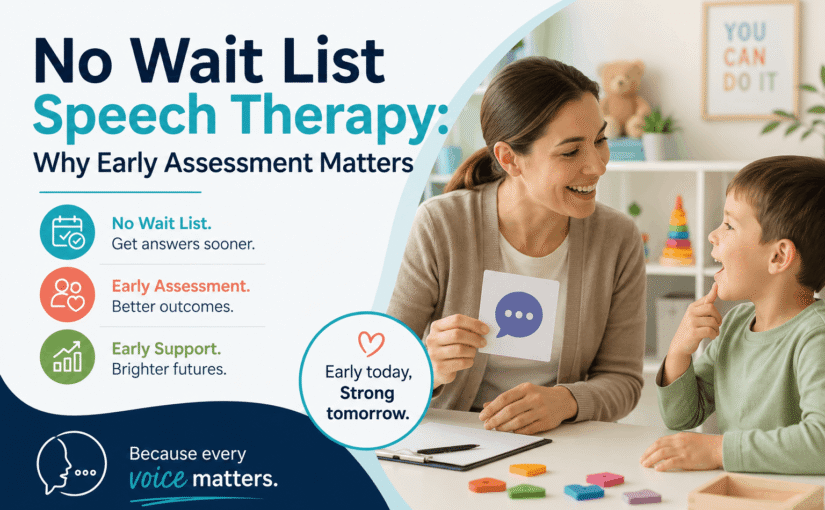
It’s common for parents to first suspect that their child is not making communication progress when they notice something is wrong, and hope that it will go away. Perhaps your toddler hasn’t said as many words as other children of his or her age, or your child has trouble with specific sounds. Changes in speech, language, voice or communication skills are also concerns for adults.
However, many families delay seeking speech therapy services due to not knowing whether a child requires it or encountering lengthy waitlists for services and/or evaluations. Unfortunately, if you wait too long, it will be harder to deal with communication difficulties.
That is why it is important to have access to no wait list speech therapy. By assessing early, persons can obtain professional guidance earlier, be aware of their communication needs and start therapy in time.
In this article, we’ll look at the importance of early speech therapy assessments, some of the issues that families encounter when looking for a speech therapist, and how early intervention can make a difference for both children and adults.
Why Early Speech Therapy Assessment Is Important
The ability to communicate effectively and fluently is an important part of everyday life. They impact children’s development in learning, social interaction, emotional expression and academic achievement. Communication skills affect relationships, work efficiency, confidence and quality of life in adult’s life.
An early speech therapy evaluation will determine:
- Speech delays
- Language disorders
- Articulation difficulties
- Stuttering
- Social communication challenges
- Voice disorders
- Autism-related communication needs
- Difficulty communicating after a stroke or neurological illness
It is important that these challenges are identified as early as possible so that support can be given as early as possible.
Many parents think that if they are seeking an assessment, then there is something wrong with their child. In fact, an assessment is nothing more than a piece of clarity. It helps decide if treatment is required, and makes suggestions based on their needs.
The Cost of Waiting
The notion that communication issues will “get better with time” is one of the largest misconceptions. Some kids may catch up on their own, while others need professional help to learn the vital communication skills they need.
When an assessment is postponed, it can result in:
Academic Challenges
Children with speech and language issues may have a problem with:
- Reading comprehension
- Vocabulary development
- Following instructions
- Classroom participation
- Writing skills
Communication difficulties are more likely to be noticeable as academic demands grow.
Social Difficulties
Communication is a critical component in the development of friendships and social confidence. If a child is not able to communicate, then he/she might suffer from:
- Frustration
- Social withdrawal
- Difficulty making friends
- Reduced self-confidence
Early intervention supports children to learn to communicate with peers and adults effectively.
Emotional Impact
Many children become frustrated when they cannot express their thoughts, needs or emotions clearly when communication is difficult. This frustration can impact self-esteem and confidence over time.
Adults with communication difficulties can also have heightened stress, anxiety and a lack of social interaction.
When families seek out speech therapy, they often encounter a number of issues. Families looking for speech therapy may have a few issues.
It’s not always easy to find the right speech therapy clinic. Frequently, many families face barriers before making an appointment.
Long Wait Lists
One of the most frequent problems is the wait time.
Parents often hear:
- The next assessment will be in three months.
- Currently, he is taking patients for next year.
- Wait for them to let you know when they are ready to accept your application.
These delays can be worrisome and discouraging to families already feeling concerned about their child’s development.
A no wait list speech therapy clinic helps families receive professional support in a timely manner, alleviating uncertainty and helping them to move forward with confidence.
The first is not knowing if you need therapy. The first is when you’re not sure if therapy is necessary.
It takes many months for many parents to look online and compare their child to others.
Questions often include:
- Am I just a late talker?
- Will it be OK to wait another couple of months?
- Is this typical for their age?
- When is it time to get worried?
Scheduling Challenges
It is difficult for many working parents to obtain appointments that work for them.
Common concerns include:
- Limited evening appointments
- No available weekend time slots
- Long travel times
Ensuring that treatment is coordinated with school and work. Involving school and work around therapy.
Treatment can be more accessible and convenient due to flexible scheduling.
All children grow at their own rate and some may be at a point where they require professional support.
Think about an assessment if your child:
- Has fewer words than age-appropriate
- Lacks is unable to link words together to make a phrase
- Has difficulty taking turns or waiting their turn
- Is difficult for others to understand
- Gets frustrated when attempting to communicate
- Lacks a social skill of relating to peers
- Stutters frequently
Trust your instincts. An assessment can be useful if you have concerns and can give you information and guidance.
Early Intervention is a pathway to better outcomes.
A big factor in wanting to get speech therapy for your child early is because the earlier they get help the better.
The brain of young children is very malleable. They are learning language, communication, social and learning skills very quickly during this time.
Early speech therapy will help:
- Improve communication skills
- Strengthen language development
- Encourage literacy and academic achievement
- Build confidence
- Enhance social interactions
- Reduce frustration
The sooner the earlier problems are solved, the more chances there will be for significant improvement.
Speech Therapy for Kids is Not Just for Kids!
Many people think of speech therapy when they think of children, but adults can be assessed and treated, too.
Adult Speech Therapy may be useful for people who are having difficulty with the following:
Stroke Recovery
Speech-language pathologists can help people who have communication problems and aphasia or speech disorders as a result of a stroke.
Stuttering
Many adults with stuttering want to seek therapy in order to become more fluent and more confident in their communication skills in personal and professional life.
Voice Disorders
Voice therapy can help people who use their voice a lot at work with voice strain, hoarseness or voice fatigue.
Neurological Conditions
Speech therapy can help people with Parkinson’s disease, traumatic brain injuries and other neurological disorders that impact communication.
As with kids, people tend to do better when they get help at an earlier age.
What is involved in a Speech Therapy Assessment?
Many families are apprehensive about taking an assessment, not knowing what to expect.
A Speech Therapy Assessment will generally involve:
Discussion of Concerns
The speech-language pathologist will collect data related to communication problems, developmental history, and goals.
Observation
The clinician will assess communication skills in structured activities, conversation or play.
Standardized Assessment
Formal assessments can be used to assess speech, language, voice, fluency or social communication skills depending on the individual’s age and needs.
Recommendations
After the assessment, you will be provided with expert suggestions for:
- Recommendations for treatment
- Areas requiring support
- Suggested treatment plans
- Home strategies
- Follow-up services
The process will be informative, supportive and tailored.
Why Families Choose No Wait List Speech Therapy
Families are likely to want answers from speech therapy services as soon as possible. The months-long delay between assessment can cause a loss of momentum and stress.
There are a number of benefits to no wait list speech therapy:
Reduced Anxiety
Parents have an understanding of their child’s next steps and development.
Earlier Intervention
Early intervention for therapy, which can take place before communication skills are developed.
Better Long-Term Outcomes
Early intervention can help to improve confidence and progress more effectively.
Personalized Care
Families are given personalized suggestions that are based on their specific needs and objectives.
Taking the First Step
Don’t wait until a problem becomes more serious if you have concerns about your child’s speech, language or communication skills, or if you are an adult who has communication difficulties.
An early speech therapy evaluation offers insight and information and can help plan the next steps. Even if it’s not a therapy, you’ll be at ease and have expert advice.
One of the most crucial skills that we use on a daily basis is communication. Early intervention can help to avoid future difficulties and opportunities for success at home, school, work, and in the community.
Early action makes an early difference to speech and language development. By having access to no wait list speech therapy, individuals and families can access the therapy they need without the delay, helping them to gain confidence, develop communication skills, and reach their full potential.
1. Why is it important to assess speech therapy early?
Early assessment helps identify communication difficulties in advance of their impacting on a child’s learning, social development and confidence. Early identification of concerns, the earlier support and intervention can begin.
2. What advantages does it offer to select a no wait list speech therapy clinic?
A no wait list speech therapy clinic offers quicker access to assessment and therapy, minimizing delays which can affect speech and language development. Families will get answers quicker and can start therapy without unnecessary time delays.
3. At the end of the day, what transpires during a speech therapy assessment?
A Speech-Language Pathologist (SLP) assesses speech, language, communication and social interaction skills during an assessment. Parents may share their concerns and the therapist may offer suggestions according to the person’s specific needs.
4. . Is speech therapy just for kids?
No. Speech therapy is beneficial to children and adults. Speech therapy for adults is available for a variety of reasons including stuttering, voice disorders, stroke recovery, aphasia, Parkinson’s disease, traumatic brain injuries, and more.
5. How can speech delays be improved without therapy?
Some children will catch up on their own but others need support. Assessment will be used to decide if a child is developing at their own rate or if speech and language therapy would be useful to help them communicate.
6. How long does speech therapy take to show results?
The timeline is dependent on the individual’s age, objectives and communication requirements. Some people see improvement within a couple weeks, others may need continuing treatment. Regular attendance and practising strategies at home can help to improve outcomes.