
Introduction
Communication is an important part of daily life. Good communication is vital in a variety of situations, including expressing thoughts and feelings, developing relationships, and succeeding in school or in the workplace. But, there are a lot of children and adults who have speech, language, voice, fluency or social communication issues. This is where speech therapy can help.
Summarize This Article With AI
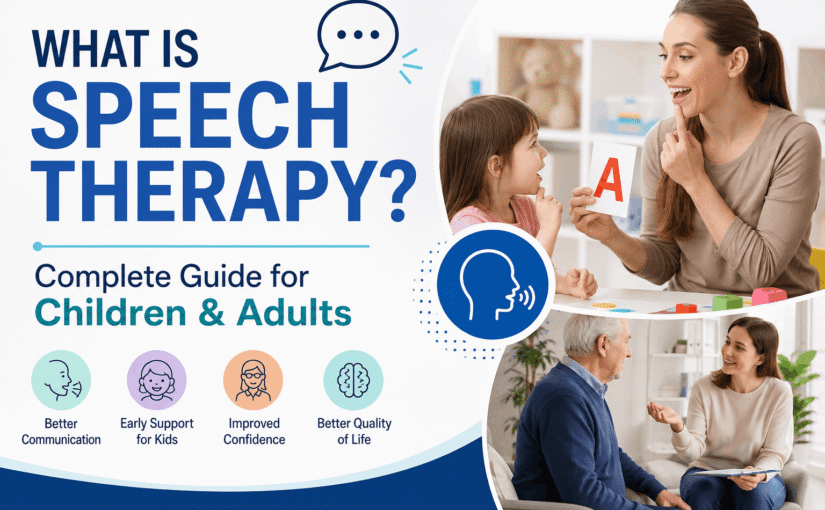
Speech therapy covers the area of special treatment for the improvement of communication, speech, language comprehension, voice and swallowing. Provided by trained professionals known as speech-language pathologists (SLPs) or speech therapists.
Speech and language therapy can have a huge impact on confidence, communication and quality of life for a child whose speech and language development is delayed or for an adult who has recovered from a stroke.
Speech therapists at Speech Specialists are trained to evaluate communication difficulties in children and adults and develop individual treatment plans to help them make progress over the long-term.
Speech Therapy – What Does It Mean?
Speech therapy is a health and education service that deals with the diagnosis, evaluation and treatment of communication and swallowing disorders. It facilitates the ability to speak clearly, comprehend language, communicate and to express ideas.
Speech/language therapy can assist with:
- Speech delays
- Language disorders
- Stuttering
- Voice problems
- Pronunciation difficulties
- Autism-related communication challenges
- Swallowing disorders
- Social communication difficulties
- Post injury / stroke cognitive communication problems
Speech therapy sessions are specific for the person’s age, condition, needs and capacity. Depending on the child, therapy can include voice training, communication exercises, cognitive exercises or play-based learning.
For more information on speech language pathologist services, visit Speech Specialists Speech Therapy Services.
What is a Speech Therapist?
Speech therapist (speech-language pathologist) assesses and treats disorders of speech, language, communication and swallowing.
Their role includes:
- Evaluating speech and language skills
- Diagnosing communication disorders
- Designing individual therapy plans
- Introducing speech therapy activities
- Pronunciation and articulation skills will be improved.
- Able to assist with fluency and stuttering
- Assisting children with social interaction abilities
- Providing training for parents/caregivers
- When necessary, giving swallowing therapy.
Children from toddlers learning their first words to seniors recovering from neurological issues are all served by speech therapists.
Who is the speech therapist for?
Speech therapy is helpful to children and adults with communication issues.
Children who may require speech therapy.
Children may benefit from pediatric speech therapy if they:
- Have a slow start to speech
- Have difficulty pronouncing sounds
- Have difficulty combining words into sentences.
- Have trouble understanding language
- Stutter
- Be an autistic person
- Have difficulty with social interaction with others
- Experience feeding or swallowing problems
Some parents may detect delayed milestones, frustration in talking and difficulties with speech.
Adults who may require speech therapy.
Speech and language therapy may be needed for adults for a number of reasons:
- Stroke Recovery
- Brain injury
- Parkinson’s disease
- Dementia
- Voice disorders
- Stuttering
- Accent modification
- Neurological disorders
Speech therapy can help adults restore their communication abilities, enhance voice quality and gain independence.
There are different types of communication disorders addressed in Speech therapy.
Speech-language pathology covers many types of communication disorders.
1. Articulation Disorders
Articulation disorders are when an individual is unable to make certain speech sounds properly.
Examples include:
It’s OK to say ‘wabbit’ instead of ‘rabbit’.
Struggling with “s,” “r” or “th” sounds
2. Language Disorders
Language Disorders involve comprehension or communication of language.
- Receptive Language Disorder
- Inability to understand speech.
- Expressive Language Disorder
- Problems in finding words to express thoughts and ideas.
3. Fluency Disorders
Fluency Disorders are impairments in the flow of speech.
The most frequently seen is stuttering, in which the speech may contain:
- Repetitions
- Prolongations
- Blocks
4. Voice Disorders
Voice disorders are any disorder of pitch, volume or vocal quality.
Symptoms may include:
- Hoarseness
- Weak voice
- Vocal strain
- Chronic voice fatigue
5. Speech Disorder (Not otherwise specified)
An apraxia is a motor speech disorder in which the brain has difficulty making movements for speech.
Children with apraxia can:
- Make speech errors that vary from time to time.
- Have difficulty with longer words
- Speak less distinctly than peers
Benefits of Speech Therapy
Speech therapy helps you improve communication, learning, social interaction and confidence for life.
Improved Communication Skills
Speech therapy can assist individuals to:
- Speak more clearly
- Understand language better
- Express thoughts effectively
- Improve conversational skills
- Increased Confidence
A lack of communication can impact self-esteem. As the speech and language skills improve, so does the person’s confidence in social, academic and work situations.
Better Academic Performance
Children who are confident in their communication skills tend to do well in:
- Reading
- Writing
- Classroom participation
- Social interaction
- Enhanced Social Skills
Speech therapy supports:
- Eye contact
- Turn-taking
- Understanding emotions
- Building friendships
- Enhancing the quality of life.
An adult recovering from an injury or illness can get back to independence and enhance their everyday communication skills.
How Speech Therapy Works
The speech therapy process is generally a structured process.
Step 1: Assessment and Evaluation
Speech therapist does a speech evaluation to assess communication strengths and challenges.
This may include:
- Speech sound testing
- Language assessments
- Oral motor evaluation
- Voice assessment
- Fluency analysis
Step 2: Goal Setting
Based on the evaluation, the therapist creates personalized goals.
Examples:
- Improve pronunciation
- Increase vocabulary
- Reduce stuttering
- Improve social communication
Step 3: Therapy Sessions
During therapy sessions, they might also engage in:
- Speech therapy exercises
- Language activities
- Interactive games
- Reading exercises
- Conversation practice
- Oral motor activities
Step 4: Home Practice
Home practice is important to advance. Parents and carers may be provided advice about activities to continue in between therapy sessions.
Exercise caution when the child lies on their back. Take care of the child’s back position.
Evidence-based techniques are used by speech therapists based on the individual’s needs.
Speech Therapy Techniques and Activities
Articulation Therapy
Works well at making speech sounds correctly; uses:
- Modeling
- Repetition
- Sound placement cues
Language Intervention Activities
Helps improve:
- Vocabulary
- Sentence structure
- Understanding language
- Conversation skills
Play-Based Therapy
Play Therapy is a widely used therapy technique in children’s speech therapy to engage children and develop communication skills.
Activities may include:
- Storytelling
- Puzzles
- Songs
- Role-playing
- Games
Oral Motor Exercises
These exercises help to build up the strength of muscles used for talking and swallowing.
Fluency Therapy
Indications: stuttering, fluency disorders.
Techniques may include:
- Controlled breathing
- Slow speech
- Pausing strategies
AAC Therapy
AAC (Augmentative and Alternative Communication) is designed for people unable to communicate verbally.
Examples include:
- Communication boards
- Speech-generating devices
- Picture systems
Speech Therapy for Kids
Early intervention often has the greatest benefits for children.
Pediatric Speech Therapy can treat:
- Speech delay
- Language disorders
- Autism communication challenges
- Social communication difficulties
- Feeding issues
The importance of early intervention.
Children can benefit from early treatment by:
- Develop language skills at a more rapid rate
- Improve school readiness
- Build confidence
- Reduce frustration
Evidence indicates early intervention can have a tremendous impact on long-term communication results.
Try Free Speech and Language Screening Test for Kids Start Free Screening Test
Speech Therapy for Adults
Speech therapy is not limited to kids. Treatments for communication and swallowing problems are also available for adults.
The following is a list of conditions that adults can receive treatment for:
Adult Speech Therapy may be beneficial for:
- Stroke recovery
- Aphasia
- Parkinson’s disease
- Brain injuries
- Voice disorders
- Stuttering
- Cognitive communication disorders
Try Free Accent Screening Test Start Accent Screening Test
Topics that are suitable for the focus of an adult speech therapy session.
Treatment can be directed toward:
- Regaining speech abilities
- Enhancing memory and verbal ability
- Strengthening voice quality
- Increasing speech clarity
How Many Speech Therapy Sessions?
How long speech therapy session will last will depend on the following:
- The level of severity of the disorder
- The person’s age.
- Frequency of sessions
- Home Practice: Consistency
- Motivation and participation
Evolution can take place within a few months in some people, and in others may be a long-term process.
Good attendance and practice at home typically results in improved performance.
Here are some indicators when to seek out the help of a speech therapist.
Talk to your speech therapist if your child or loved one:
- Is difficult to understand
- Is not reaching early speech and language goals
- Has trouble understanding instructions
- Stutters frequently
- Avoids speaking
- Experiences voice strain
- Has difficulty swallowing
- Communication issues or difficulties – struggles socially.
Early evaluation can help to identify problems in their early stages before they become more serious.
Is Online Speech Therapy possible?
Yes. Teletherapy or on-line speech therapy is becoming a popular alternative.
The benefits of virtual speech therapy are that someone can:
- Convenient access to therapy from the comfort of home.
- Reduce travel time
- Continue consistent treatment
- Get parent coaching via the internet
There are many speech and language disorders that can be effective treated in online sessions.
FAQs About Speech Therapy
Ques: Does speech therapy only apply to kids?
Ans: No. Speech therapy can be utilized by children and adults who have communication and swallowing problems.
Ques: What is the best age for speech therapy?
Ans: Speech therapy services may start as early as infancy if there are any concerns.
Ques: Is there speech therapy for autism?
Ans: Yes. Speech therapy frequently improves the way autistic people communicate, socially, and with regard to language skills.
Ques: How many speech therapy sessions are there per week?
Ans: Frequency is dependent on the requirement but many people go weekly.
Ques: Does speech therapy work for adults?
Ans: Yes. Speech therapy can be of great benefit to adults who have suffered from stroke, injury or neurological disease.
Ques: Is home important for speech therapy exercises?
Ans: Yes. Home practice supports skills acquired in therapy sessions.
Final Thoughts
Speech therapy can benefit anyone regardless of age to enhance communication, speech clarity, language skills, confidence and quality of life. Early support and tailored therapy can be of great significance to a child who is late to speak or to an adult recovering from a medical condition.
Professional speech-language pathology services offer the tools, strategies, and guidance necessary to overcome communication challenges, and to be successful in the long run.
For parents, if you need an expert opinion on speech and language therapy for children or adults, take a look at Speech Specialists Canada for therapy programs and professional help.